
Ukraine's Self-Sabotage
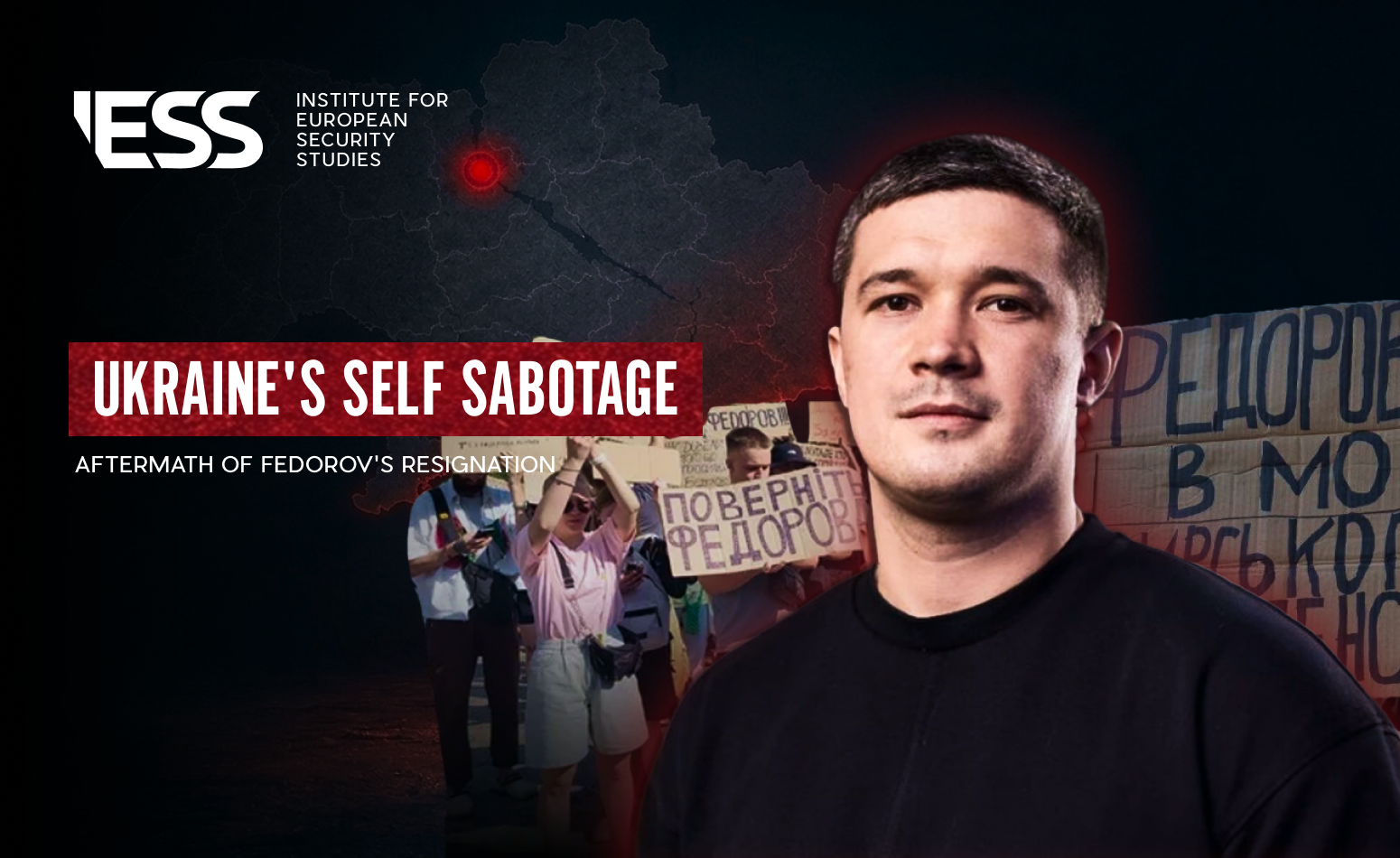
Aftermath of Fedorov's resignation
On July 14, the Verkhovna Rada dismissed Yuliia Svyrydenko's government. Mykhailo Fedorov, who had led the Ministry of Defense for the previous six months, left his post along with the rest of the Cabinet. The next day, it became known that President Volodymyr Zelenskyy had decided not to put his name forward for the new government, now headed by Serhii Koretskyi, the former head of Naftogaz/Ukrnafta.
At first glance, this looked like one episode in a broader Cabinet reset that touched mainly the energy and logistics blocs.
Yet the reaction to this particular episode was out of proportion to an ordinary personnel rotation. Within hours, peaceful rallies in support of Minister Fedorov took place simultaneously in Kyiv, Lviv, Kharkiv, Odesa, Dnipro, Chernivtsi, Lutsk, Rivne, and other Ukrainian cities.
That is the starting point of our analysis: behind this personnel decision lies a fundamental, long-overdue choice between two philosophies of how Ukraine fights this war and how it treats those who fight it.
IESS identifies five key dimensions of this story.
1. Two philosophies of war: technology against manpower
Arriving at the Ministry of Defense six months ago as the long-serving head of digital transformation dating back to Oleksiy Honcharuk's first government in 2019, Fedorov brought with him a logic native to the IT sector rather than to the military chain of command: audits, open and transparent procurement, mass use of polygraphs, and a bet on data over hierarchy. By his own account, the ministry bought more drones in the last five months alone than in the entire previous year, while an internal audit uncovered roughly 300 billion hryvnias in excess spending.
That logic inevitably collided with a more conservative military culture built around a chain of command rather than horizontal data flows. The conflict with Syrskyi, by Fedorov's own account, began in his first days on the job and never let up. This is not a clash of two personalities but a classic systemic collision of two worlds: innovative management and a conservative military establishment, where the first measures success by how efficiently it destroys the enemy per unit of resource, and the second by the discipline and controllability of the chain of command. Both ways exist for a reason.
2. The citizen in uniform: minimizing risk versus compulsion
This clash of philosophies has a very concrete dimension that goes beyond procurement and bureaucratic infighting: how the state treats human life at the front. One logic, which Fedorov publicly championed, is to "lose drones, not people" first, and only send in infantry once technology has done most of the work. The other logic still relies heavily on assault units manned under the pressure of coercive mobilization. The loudest symbol of that model's risks became the 425th Separate Assault Regiment "Skelya": following a journalistic investigation by the outlet Babel, which counted at least 26 non-combat deaths among new recruits between late autumn 2025 and spring 2026 (most from severe pneumonia, cardiovascular complications, and other illnesses shortly after being drafted), Ukraine's State Bureau of Investigation opened a pre-trial case on June 24, Ombudsman Dmytro Lubinets took the matter under his personal control, and the regiment's commander, Lieutenant Colonel Yuriy Harkavyi, was suspended from duty for the duration of the review.
The regiment itself rejected part of the accusations, insisting some problems had already been fixed months earlier, while on June 30, Commander-in-Chief Syrskyi himself publicly called the situation "a shameful story" for the army of a country at war, even though final legal conclusions on the regiment's command have not yet been reached.
Fedorov himself publicly connected these two issues, saying the mobilization problem cannot be solved without a new social contract and a genuine change in how servicemen are treated, and noting that territorial recruitment centers answer to the Ground Forces, and through them, to the Commander-in-Chief himself.
In individual tactical episodes, either approach can be effective, but at the level of state strategy, Ukraine cannot afford to treat preserving lives and combat effectiveness as a trade-off – and it is precisely the combination of these two goals, rather than a choice between them, that has begun to take shape in recent months.
3. Familiar Ukrainian cycle: Hope and its withdrawal
Ukraine's political history since 2013 has moved to a recognizable rhythm: a period of hope, followed by its sudden withdrawal. Yanukovych's refusal to sign the Association Agreement in November 2013, after years of pro-European expectations, was the detonator for the Maidan. The creation of NABU was a symbol of hope for a systemic fight against corruption, and last year's attempt to strip the bureau of its independence became a symbol of that hope's loss, until mass protests forced a restoration of the status quo.
Fedorov was the last remaining member of Honcharuk's original 2019 government still in office, a living embodiment of that era's founding promise of a digital, efficient, less bloody state. His dismissal, without a clear public explanation, fits naturally into that same pattern of perception. It is not about the loss of a specific person in the team, but yet another episode in which an understandable, functioning approach is rolled back without explanation – and it is the absence of an explanation, not the personnel decision itself, that has historically triggered Ukraine's sharpest public reactions.
4. Proof already visible on the map: Russia's collapsing logistics
Whatever the bureaucratic disputes, the results of the bet on technology are already measurable on the ground. In previous work, this Institute documented how strikes by medium-range drones, precisely the weapons class whose development Fedorov consistently accelerated as part of the broader concept of "war by drones, not bodies," have led to an effective paralysis of shipping in the Sea of Azov: the closure of the Kerch Strait and the Don-Azov Canal, queues of vessels near Rostov-on-Don, and disrupted logistics for a quarter of Russia's wheat exports.
This is not an incidental fact but a direct operational consequence of the doctrine the minister championed. Whatever one's assessment of his management style, the effect of that doctrine can no longer be denied: it is visible in satellite imagery, not just in bureaucratic reports.
5. A decision already final, and the society that noticed
The paradox is that, by the time of writing, the decision is already final: the president never formally submitted Ihor Klymenko's candidacy for defense minister, the post of acting defense minister is most likely to go to Yevhen Khmara, the acting head of the SBU, and yet Fedorov, who has not been resigned by parliament, himself has publicly voiced hope that the decision "will be corrected," adding that he has known Zelenskyy for seven years and believes he "has not yet chosen Syrskyi's side." He explained his need for the post not as personal ambition but as necessary "to win the war," noting that under "the current configuration," he doesn't see how that is possible.
It is precisely this ambiguity, not the mere fact of a possible ministerial change, that keeps fueling protests in cities across the country. We do not consider this decision to be either final or one that automatically spells disaster for defense reform – the problem is not that a worse scenario for Ukraine is inevitable, but that an understandable, results-driven approach is being rolled back without a public explanation of why, and that deficit is exactly what has historically turned personnel decisions into public trauma.
Conclusion: The Choice Ukraine cannot postpone
This is not about a rivalry between two officials, but a choice between two models of waging this war and two models of the relationship between the state and the person in uniform. The first model has, for the first time in recent months, begun to produce measurable results: fewer personnel losses alongside a growing effectiveness of strikes deep into Russian logistics. Abandoning it silently, without explaining to the public the reasons and the way forward, risks not just this one reform, but the trust society still places in the decision-making process itself.
Ukraine is unlikely to lose this war for lack of courage among its people. What it genuinely risks is losing, once again, its chance to fight with drones instead of bodies, if that choice is once more made in silence.