
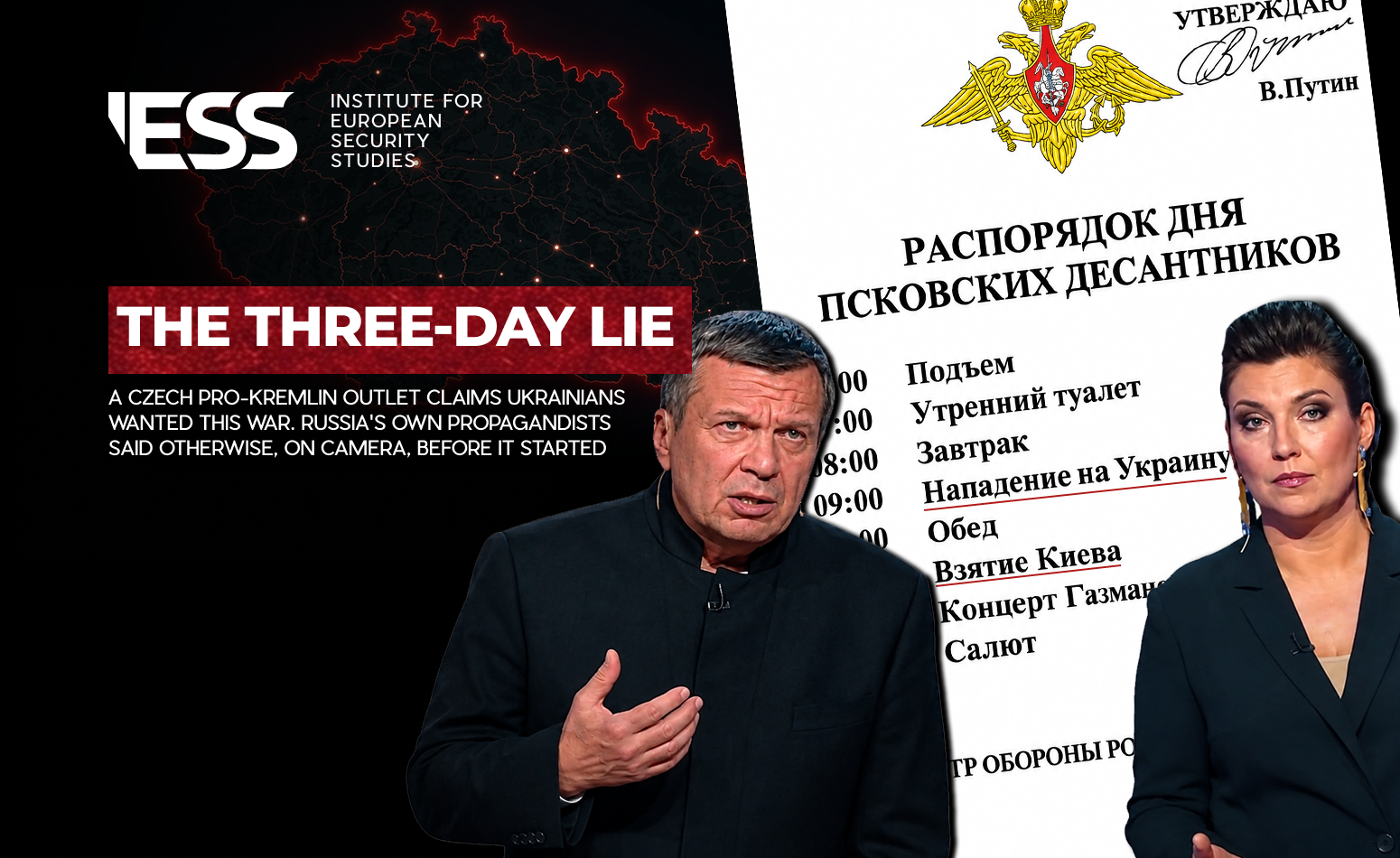
The Three-Day Lie
A Czech pro-Kremlin outlet claims Ukrainians wanted this war. Russia's own propagandists said otherwise, on camera, before it started
A Czech commentator named Daniel Sterzik-Vidlák published a column this week in Nová republika, a Czech outlet that markets itself as independent media but functions, article after article, as a distribution channel for Kremlin talking points. His argument was blunt even by that outlet's standards: no Russian official, he wrote, ever promised to take "Kyiv in three days."
Ukrainians wanted a total war of revenge against "evil Russians," he continued, and simply failed to grasp what that would cost them, a cost he described in the language of exit wounds. It reads less like commentary than like an attempt to hand Vladimir Putin a legal defense in the court of European public opinion, and it deserves to be answered on the merits, because the underlying claim, that Ukraine somehow brought this war on itself, keeps resurfacing in slightly different clothing across Europe's information space.
Who actually decided to invade
Start with the basic sequence of events, since the column depends on scrambling it. Russia spent months before February 2022 massing troops and equipment along Ukraine's borders under the cover of military exercises, an open buildup that Western intelligence services tracked and warned about in real time.
Ukraine's own government spent that same period trying to avoid war through diplomacy, working the phones in Washington, Brussels, and Moscow itself in an attempt to talk Putin out of a decision Ukrainian officials did not control and could not have prevented through concessions of their own, because Ukraine had not attacked Russia, threatened Russian territory, or done anything that could plausibly justify an invasion under any recognized standard of international law.
The decision to go to war belonged entirely to the Kremlin. Assigning Kyiv equal or greater responsibility for that decision isn't a matter of interpretation. It's a factual inversion of who did what to whom.
The three-day promise nobody made
Sterzik-Vidlák's specific claim, that no Russian voice ever promised a lightning victory, is also simply false, and conveniently checkable. Margarita Simonyan, one of the Kremlin's most prominent state propagandists, said publicly before the invasion that in the event of a "hot war," Russian forces would take Kyiv within three days.
That statement exists on the record. It reflected what Kremlin planners themselves genuinely expected: a fast collapse of Ukrainian resistance, a swift change of government, and a short, containable operation rather than the grinding, multi-year war that followed.
The plan's failure in the first weeks of the invasion doesn't mean the plan never existed. It means Russian intelligence badly misjudged Ukraine's willingness to fight and badly overestimated its own army's competence, an error of Kremlin arithmetic that a Czech columnist is now trying to recast as evidence that Russia never intended a quick war in the first place.
Resistance is not the cause of a war
The claim that Ukrainians wanted "total war" and revenge collapses just as quickly against Ukraine's actual conduct since 2022. Ukrainian leaders have repeatedly said they would end the fighting under a just peace built on respect for Ukraine's sovereignty and territorial integrity.
What Moscow has offered instead are terms that amount to significant territorial and political concessions, land transfers, limits on Ukraine's alliances, and constraints on its own armed forces, dressed up as a path to peace.
A country continuing to resist an invading army under those conditions is not pursuing vengeance. It is refusing to be occupied. Treating that refusal as the reason the war continues erases the distinction between the party demanding capitulation and the party being asked to provide it.
Blaming the victim for the wound
The column's imagery, Ukrainians paying for their supposed desire for revenge with "shot-through bellies," makes the underlying logic explicit in a way most Kremlin-aligned commentary tries to soften. Destroyed apartment blocks, dead civilians, and mass missile and drone strikes on Ukrainian cities are the direct product of a Russian military campaign, not the natural consequence of a Ukrainian choice.
Framing them as something Ukrainians brought on themselves by refusing to submit is a version of an old and dangerous argument: that a stronger power is entitled to use force, and the state on the receiving end is expected to absorb it quietly rather than fight back. A country's right to defend itself does not convert the country that attacked it into the aggrieved party, no matter how the casualties are described.
Why this argument travels
None of this is really about winning an argument with one Czech columnist. The point of casting Ukraine as the true author of the war is to reshape how European audiences weigh Russia's actual demands. If enough Europeans come to believe the war persists because Kyiv refuses to negotiate, Moscow's territorial and political conditions start to look, by contrast, like a reasonable compromise rather than an ultimatum backed by continued killing.
That reframing is the entire commercial value of a piece like Sterzik-Vidlák's, and it is exactly why European readers and editors need to recognize it for what it is rather than treat it as one more opinion in a crowded debate.
The principle at stake isn't abstract. If the argument that victims of aggression are responsible for the consequences of their own resistance is allowed to take hold, it doesn't just weaken support for Ukraine. It erodes the norm against altering borders by force that European security has rested on since 1945, and offers a ready-made script to any government contemplating the same move against a neighbor next.