
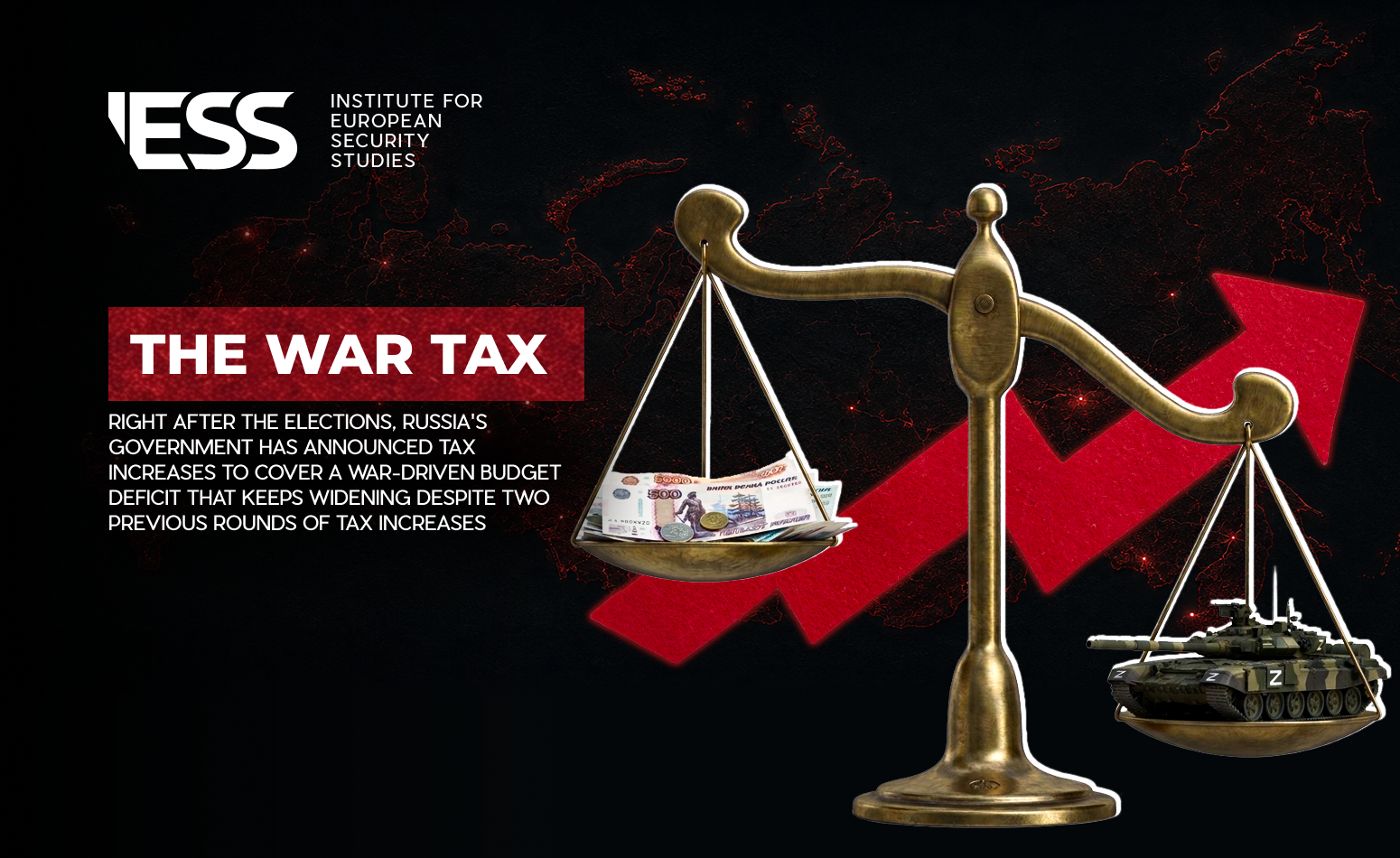
The War Tax
Right after the elections, Russia's government has announced tax increases to cover a war-driven budget deficit that keeps widening despite two previous rounds of tax increases
Russia's Finance Ministry has sent parliament a new package of tax increases, and the range of what it touches is truly serious. Passive income, interest, dividends, gains on securities and property, will now be folded into an individual's general income and taxed at up to 22%, rather than the 13-15% it faced before. Mutual funds, previously exempt, will owe a 15% tax on the passive income they generate for savers. Foreign parcels, currently untaxed, will carry a 22% VAT plus a flat customs fee. Mining and metals firms face a new 30% windfall levy on profits tied to rising world prices, 20% for gold producers specifically.
None of these are targeted fixes for narrow problems: they are a general tightening across nearly every channel through which money moves in the Russian economy, and this is the third consecutive year Moscow has reached for exactly this tool.
What the war actually costs
The reason isn't a mystery, even if the government prefers not to state it plainly. Janis Kluge, an economist at Germany's Institute for International and Security Affairs, calculates that Russia spent 10.7 trillion rubles on its military and weapons procurement in the first half of this year alone, about a third more than the same period last year.
Defense and security now account for 43.8% of all federal budget spending and consume 57.3% of everything the state collects in taxes. By year's end, Kluge expects military spending to reach roughly 9% of GDP, the highest share Russia has carried since the Soviet era. A tax package this broad, arriving on this schedule, is not primarily an economic policy.
It is a bill being sent to Russian savers, shoppers, and mining companies for a war whose costs the existing tax base can no longer cover on its own.
Everyone pays something, almost
The new measures are notable for how evenly, and how selectively, the burden is spread. The higher passive-income tax will hit roughly 4 million Russians who hold savings, dividends, or property, with one conspicuous carve-out: participants in what Russia calls its "special military operation" are excluded. Utility tariffs, already raised 1.7% in January because of a VAT increase, are due for a second hike of 8-22% in October, a rise the government had quietly delayed until after this year's elections were safely finished. Recycling fees on vehicles are set to climb another 10-20% starting January 2027.
And in a detail that gives away more than its authors probably intended, Russia's antitrust regulator has proposed raising electricity tariffs specifically for businesses to help fund protection of the power grid from drone strikes, an unusually direct admission that the physical cost of the war is now showing up on the invoice.
The first bill, not the only one
The timing here is not incidental. The October tariff increase, the tax package itself, and the January recycling fee hike form less a single announcement than a rolling schedule, one the government held back until the State Duma vote on September 18-20 was safely behind it.
That sequencing suggests this package is best read as the opening item on a longer list rather than a one-time correction. With the election calendar now clear until the next cycle, the Kremlin has considerably more room to introduce unpopular measures without an immediate ballot box to answer to, and a budget deficit still widening despite two prior years of tax increases gives it every practical reason to keep doing so. Russians should expect this to be the first uncomfortable fiscal surprise timed to the period after the vote, not the last.
A hole that keeps growing anyway
What makes this package worth watching isn't just its scope, but its track record. Similar tax increases in prior years failed to close Russia's budget gap, and this year's numbers show the gap widening rather than shrinking: in the first eight months, government spending outran revenue by 5.8 trillion rubles, a deficit one and a half times larger than over the same stretch last year.
Finance Minister Anton Siluanov says the new measures will help contain the shortfall, which is now projected to double the original plan, reaching 3% of GDP, about 6.9 trillion rubles, instead of the 1.6% originally budgeted. Economists warn that squeezing further revenue out of a stagnating economy, one already facing what the Ministry of Economic Development itself now expects to be its longest investment slump in a decade, with no recovery likely before 2028, risks a wave of private-sector bankruptcies among businesses whose margins are already thin and whose reserves are running out.
So, a government that raises taxes for the third straight year and still watches its deficit grow faster than its revenue is not managing a temporary shortfall, but discovering that the war costs more than the economy underneath it can permanently sustain.
Therefore, there are only so many new categories of income left to tax before that math becomes impossible to hide behind a budget bill.