
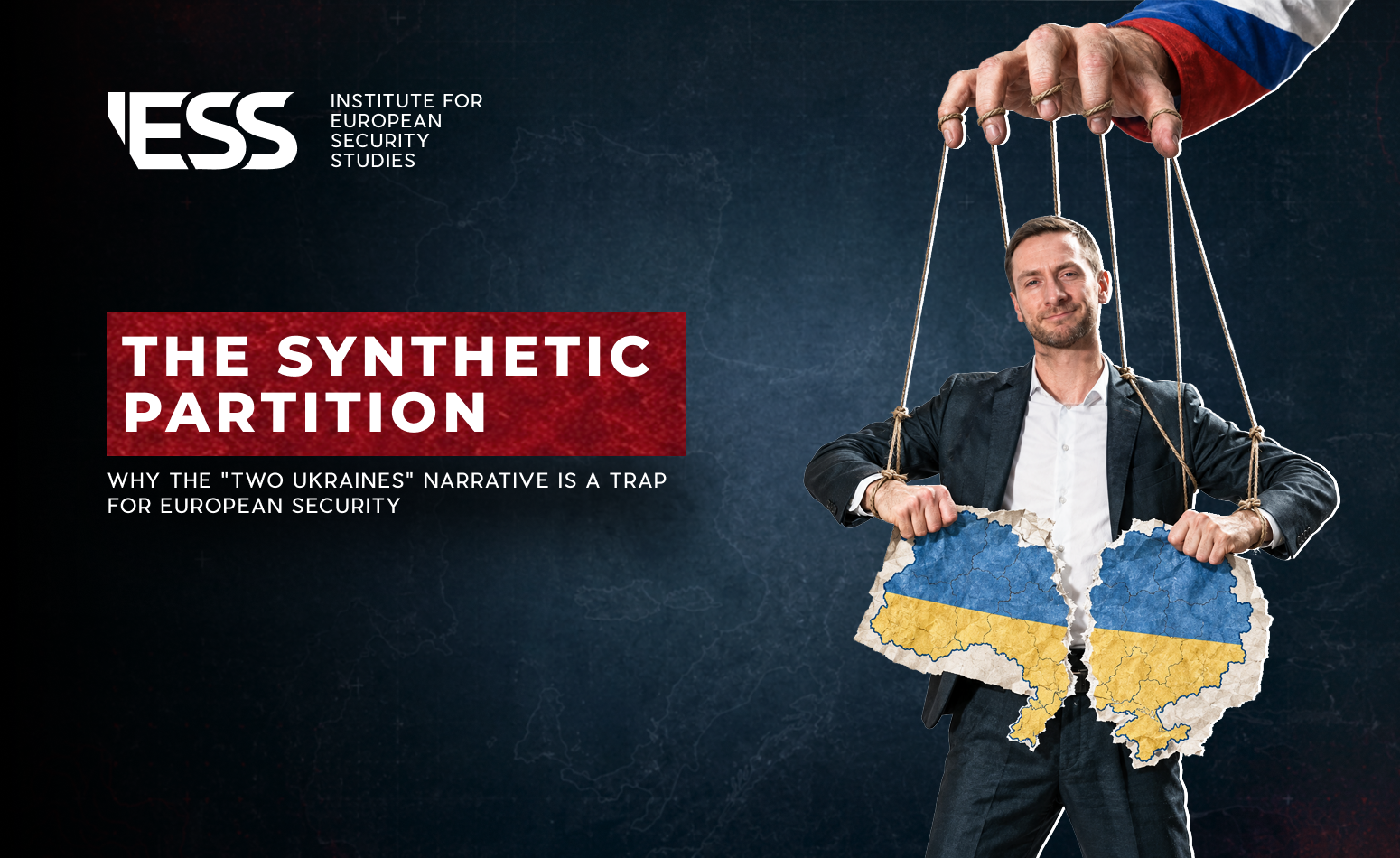
The synthetic partition
Why the "Two Ukraines" narrative is a trap for European security
On September 27, 2026, Milan Uhrík, a Slovak Member of the European Parliament and leader of the nationalist movement Republika, utilized the Czech media outlet Parlamentní Listy, a platform frequently characterized by experts as a conduit for disinformation, to resurrect a foundational myth of Russian propaganda.
Uhrík declared that the only viable resolution to the ongoing war is the partition of Ukraine, arguing that the eastern and western regions are so politically and culturally incompatible that their reunification would trigger a "civil war lasting 50 to 100 years."
And we must start from the main obvious point: this claim is not anything but calculated deployment of a Kremlin narrative designed to normalize territorial annexation. Analyzing the reality of Ukrainian society and the nature of the conflict demonstrates that the concept of "Two Ukraines" is an engineered fallacy, and validating it would shatter the foundations of European security.
Myth of the insurmountable divide
Uhrík’s argument relies on the premise that regional differences within Ukraine are unique and fatal to statehood, which fundamentally ignores the nature of modern European nations.
Distinct political, linguistic, cultural, and economic variations exist in nearly every European state: Italy, for instance, navigates stark economic and cultural divides between its northern and southern regions, yet this friction does not cast doubt on the existence of a unified Italian state.
In Ukraine, regional and linguistic nuances have never constituted a fatal flaw in the national project. Instead, Russia weaponized these natural variations. Moscow artificially inflated the narrative of "Two Ukraines" as a cognitive tool of destabilization long before using it as the kinetic justification for occupying Crimea and vast swathes of the Donetsk, Luhansk, Zaporizhzhia, and Kherson regions.
Sociology defeats propaganda
The assertion that Ukraine is fundamentally fractured contradicts empirical sociological realities.
The pressure of full-scale war has not shattered Ukrainian identity; it has forged it. According to comprehensive polling conducted by the Rating Group in August 2026 across all government-controlled territories, an overwhelming 90% of respondents identified their status as a citizen of Ukraine as deeply important to them.
Furthermore, the absolute majority associated themselves primarily with the nation as a whole, superseding regional affiliations.
This data confirms that linguistic or historical specificities have not crystallized into the hostile political camps that Uhrík describes. The "incompatible East" is a political fiction: millions of residents from eastern Ukraine have been displaced by Russian violence and their primary desire is the cessation of hostilities, security, and a return to normalcy.
To interpret the exhaustion of a population subjected to relentless bombardment as a latent desire for separatism or Russian subjugation is a profound manipulation of their suffering.
The "civil war" deception
Framing the Russian-Ukrainian war as an unresolved "civil war" or a clash between East and West is a deliberate distortion that obscures the root cause of the conflict.
The war did not organically erupt from domestic political tension: it was instigated, funded, and militarily executed by the Russian Federation, beginning in 2014.
Without external Russian military intervention and the artificial propping up of proxy forces, Ukraine possessed the democratic institutions and societal capacity to resolve its regional political debates peacefully.
Uhrík’s prediction of a "50-year civil war" following de-occupation is an attempt to paint Ukraine as a chronically failed state, incapable of internal reconciliation.
However, this ignores the demonstrated resilience of Ukrainian society.
Following de-occupation, the mechanisms of democratic governance, localized self-administration, and robust societal dialogue will be the tools of reintegration, so the forecast of inevitable internal bloodshed is a manipulative exaggeration designed solely to question Ukraine's viability as a democratic European state.
A dangerous precedent for Europe
Ultimately, promoting the partition of Ukraine as a "peaceful solution" is the most dangerous aspect of this rhetoric.
For European policymakers, accepting the forcible redrawing of borders would be a catastrophic strategic error.
Partition would validate the use of kinetic military force as a legitimate mechanism for altering internationally recognized boundaries. It would dismantle the core principle of territorial integrity that has underpinned European security since the end of World War II.
By advocating for the division of Ukraine, figures like Uhrík are not proposing a path to peace; they are advocating for a precedent that would open the floodgates for renewed territorial claims, aggression, and instability across the entire European continent.