
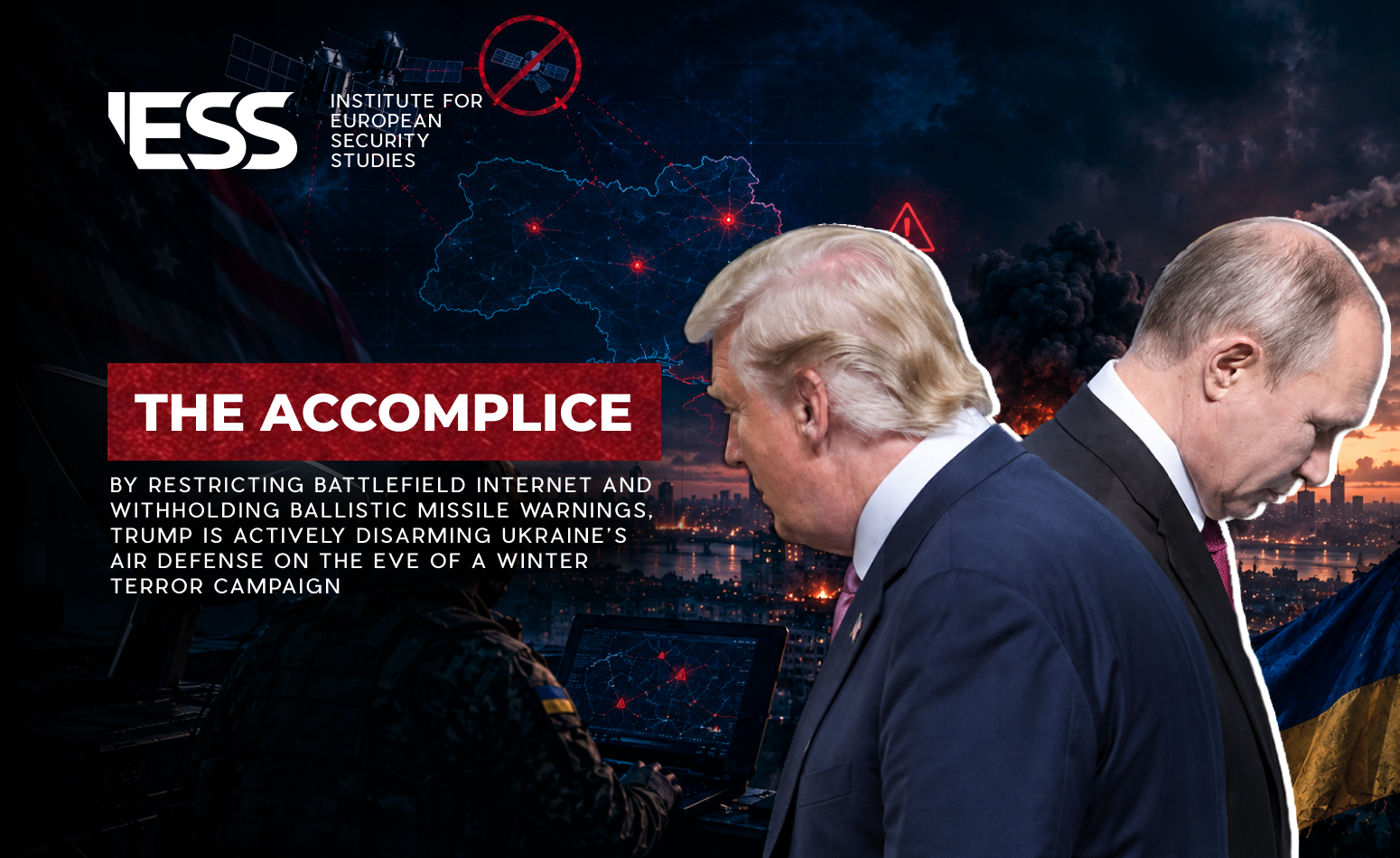
The Accomplice
By restricting battlefield internet and withholding ballistic missile warnings, Trump is actively disarming Ukraine’s air defense on the eve of a winter terror campaign
The destruction of Yandex’s supercomputers presented the United States and its European allies with a unique, closing window of opportunity to impose a total technological blockade on the aggressor.
Instead, Washington has chosen to impose a technological blockade on Ukraine.
Through a synchronized combination of commercial tech restrictions and deliberate intelligence embargoes, the US administration is actively degrading the Ukrainian Armed Forces' operational capacity. The geopolitical consequence of this policy is no longer abstract.
Therefore, by stripping Kyiv of its defensive tools just as temperatures drop, Washington has transitioned from a passive observer of Russian escalation into a de facto accomplice in the Kremlin's strategy to freeze the Ukrainian population.
Starlink sabotage
The most devastating blow to Ukraine’s defense architecture this week did not come from a Russian missile, but from a corporate policy update. SpaceX's recent decision to impose a strict 100 mph speed limit on Starlink terminals in motion – including the supposedly secure "StarShield" military packages – has fractured frontline logistics.
Starlink and its military modification are actively used on Middle Strike class drones to provide UAF satellite communication and data transmission at operational depths from tens to hundreds of kilometers.
However, SpaceX's unannounced speed limit (restricting terminals in motion, with disruptions occurring above 100 mph / 160 km/h, or even between 70-120 km/h) severely impacts these high-speed drones, making launches or mission execution extremely difficult. Notably, these Starlink-enabled drones had successfully disrupted Russian logistics, leading to a stabilization and freeze of the front lines in most sectors.
Restricting this technology now threatens to restore Russian logistics and directly assist their offensive operations.
Also, in the context of modern air defense, this arbitrary limitation is catastrophic.
Ukraine’s ability to intercept incoming jet-powered "Shahed" drones relies entirely on highly mobile air defense groups. These units require stable, high-speed broadband communication while moving at maximum velocity to track, intercept, and destroy targets before they reach civilian infrastructure. By capping the terminal speed, SpaceX has effectively blinded these mobile interceptors.
This unprecedented restriction was implemented without any prior warning to the Ukrainian Defense Forces, resulting in the real-time failure of multiple combat missions.
Although the timing coincided perfectly with the US administration’s push to lower domestic fuel prices by easing sanctions on Russian diesel, this cannot be dismissed as a benign technical update.
It is a continuation of systemic political pressure. US commercial entities and segments of the political establishment are demonstrating a willingness to sacrifice the tactical survival of an ally for the sake of backroom economic calculations.
Even after ex-Minister of Defence Mykhialo Fedorov announced that the partial restoration of Starlink operation up to 160 km/h allowing strike and interceptor drones to fly again, and the ongoing need to completely remove speed limits for Starshield, the main point still the same: US policy and actions toward Ukraine continue to reflect technological and strategic containment.
Intelligence embargo
The technological hamstringing of Ukraine’s mobile defenses has been compounded by a deliberate blinding of its strategic early warning systems. For the second time in a week, Western partners withheld advance warning of Russian ballistic missile launches.
The absence of guaranteed, continuous satellite and radar data sharing drastically reduces the time available to sound air raid sirens, deploy air defense units, and move civilians to shelters.
In the kinetic reality of ballistic warfare, withholding this intelligence directly translates to an increase in civilian casualties.
In this case, when Washington uses intelligence sharing as leverage to enforce compliance with its diplomatic agenda, it is doing so at the cost of civilian lives.
Fiction of the energy truce
The human cost of these orchestrated vulnerabilities materialized on the evening of October 13 and the night of October 14, 2026.
Following President Donald Trump’s unilateral declaration of an "energy ceasefire" – a truce Ukraine adhered to by halting strikes on Russian refineries – Vladimir Putin delivered his response.
Russia launched a massive combined attack using 128 UAVs and 39 ballistic and cruise missiles, including Iskander-M/KN-23, 3M22 Zircon, and Oniks-M systems. The primary target was the Kyiv energy node. A direct ballistic strike hit the Darnytsia CHPP-4, a critical generation and heating facility for the capital's left bank. The strikes also damaged CHPP-5, CHPP-6, the Trypilska TPP, and major substations in the Kyiv region, triggering immediate emergency power and water shutoffs.
In residential areas, burning high-rises left multiple civilians dead and dozens hospitalized in critical condition.
The Kremlin once again attempted to trigger a systemic collapse of the capital’s power grid by choosing multiple generation and transmission targets simultaneously.
Collapse of deterrence
The October 13-14 attacks must be stated as a direct challenge to the political authority of the US President: Putin has demonstratively ignored Trump's initiative, proving that Moscow views American calls for de-escalation not as boundaries, but as expressions of weakness and invitations for further aggression.
If Russia can pound Kyiv's energy infrastructure immediately after a public US decree and face absolutely no consequences, the architecture of American deterrence is effectively dead.
A ceasefire without enforcement is just an ambush, because to prevent this pause from becoming a unilateral disarmament of Ukraine, any diplomatic initiative requires strict, independent satellite monitoring and pre-agreed mechanisms of retaliation.
The first confirmed Russian strike should have automatically triggered the lifting of all restrictions on Ukraine, a pre-approved sanctions package, and the immediate dispatch of long-range weaponry.
Instead, Ukraine was met with throttled internet, withheld radar data, and political silence.
When you deny a freezing nation the intelligence to see incoming missiles and the technical capacity to shoot them down, you are not engineering peace – you are disarming the victim.