
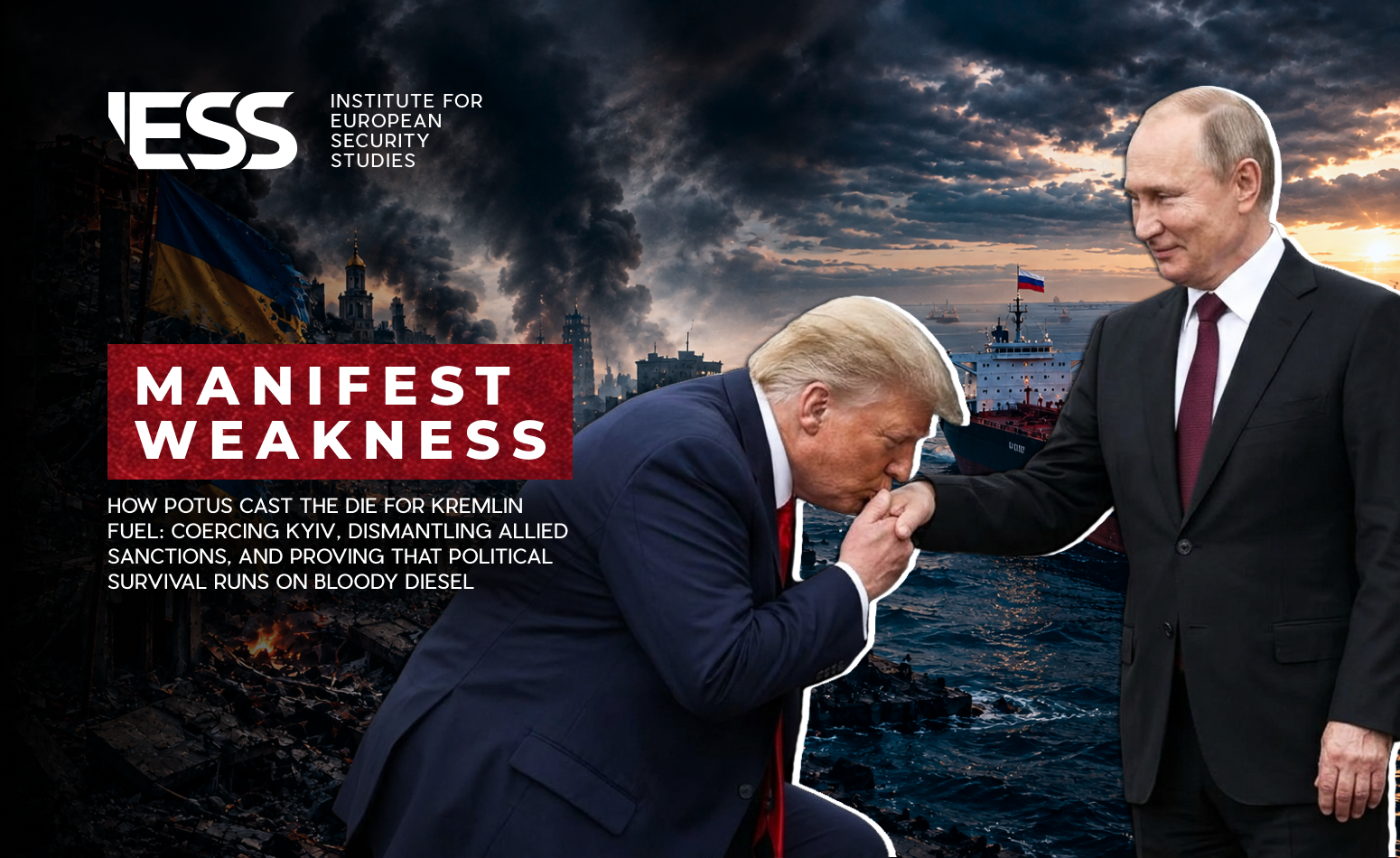
Manifest Weakness
How POTUS cast the die for Kremlin fuel: coercing Kyiv, dismantling allied sanctions, and proving that political survival runs on bloody diesel
Alea Iacta Est
The decision by the US administration to unilaterally roll back sanctions on Russian diesel exports represents a decisive rupture in Western grand strategy.
When Donald Trump announced an agreement with Vladimir Putin on October 9 to release an initial 300,000 metric tons of Russian fuel onto the global market, scaling swiftly to 1.8 million tons – the geopolitical die was cast.
Just from this point, we can judge that White House deliberately crossed the Rubicon, moving from the posture of an allied security guarantor to that of an active commercial patron of the Kremlin’s wartime economy.
The justification offered to the public was purely domestic: an emergency measure to force fuel costs down at record speed. Yet behind this populist theater lies a stark reality.
To shave pennies off retail diesel before a looming election, Trump subordinated the territorial survival of a democratic partner and the cohesion of NATO to the immediate survival of an electoral campaign.
Beyond Munich
Historical memory frequently invokes Neville Chamberlain’s capitulation at Munich in 1938 as the baseline for catastrophic diplomatic failure.
However, Chamberlain’s foreign policy, disastrous indeed, was shaped by acute war exhaustion, bureaucratic self-delusion, and a desperate desire to spare an entire generation from a mechanized slaughter.
Even so, the current posture in Washington strips away even the tragic dignity of well-intentioned error: what we are witnessing today goes past classic appeasement into open commercial complicity.
The US administration isn't “just” pressing a besieged nation to accept painful concessions for the sake of peace. Instead, it is purchasing goods from the totalitarian aggressor while forcing the victim to disarm its most effective economic leverage.
The historical counterfactual illustrates the sheer absurdity of this doctrine:
Imagine Winston Churchill ordering French forces to halt their defense in May 1940 because French strikes against German synthetic fuel plants threatened coal shipments to London on the eve of a parliamentary confidence vote.
The proposition sounds grotesque, yet that is precisely the transaction Washington executed this week.
What must be underlined and highlighted is that Ukraine strikes Russian oil refineries because cutting off refined petroleum to mechanized armies is an existential necessity during the war for saving the nation and state.
Yet, Trump stepped into the breach to protect those refineries, becoming an operational defense attorney for Russian heavy industry.
The Miami shakedown: intelligence as leverage
The operational reality of this shift was demonstrated during the trilateral discussions in Miami.
When envoys Steve Witkoff and Jared Kushner sat across from Ukrainian negotiators, they abandoned traditional diplomatic persuasion in favor of direct extortion.
According to participants, the envoys delivered an explicit ultimatum: if you continue striking Russian refinery infrastructure, Washington will end tactical military intelligence sharing.
The moral inversion of this demand was articulated with chilling candor. American officials argued that while targeting Russian distillation units certainly damages Moscow, it also imposes costs on American drivers.
In other words, the logistical supply lines of an invading army and the retail profit margins of domestic logistics firms are weighed on the same scale.
Simply by threatening to blind an ally’s battlefield command while an adversary rains ballistic missiles on civilian centers exposes the transactional rot at the heart of current US decision-making.
Therefore, having already choked off direct military assistance to Kyiv, the US attempted to strip Ukraine of its primary asymmetric weapon: long-range strike capabilities directed at the revenue engines funding Russia’s war machine.
Hormuz, inflation, and blame-shifting
The strategic dishonesty underpinning this diesel deal is rooted in an engineered scapegoat.
Global diesel benchmarks have indeed climbed relentlessly, standing more than 110% higher than at the start of the year. So, attributing this structural deficit to Ukrainian drone strikes on Volga and Black Sea refineries is an economic falsehood.

The actual spike in energy costs was generated by the administration’s own erratic geopolitical maneuvering across the Middle East: by escalating friction around the Strait of Hormuz, botched maritime deterrence, and unpredictable diplomatic swings disrupted critical tanker traffic and drove global risk premiums through the ceiling.
Facing the consequences of its own foreign policy mismanagement – and staring down an electorate infuriated by runaway inflation – the White House sought a convenient scapegoat.
And this is why Kyiv was chosen to bear that blame.
Rather than acknowledging structural vulnerabilities in the Middle East or pursuing domestic energy alternatives, Trump chose to accuse Ukraine of driving up American fuel prices.
Hence, the main acting force of NATO expects Ukraine to fight a modern industrial war with both hands tied behind its back, demanding that its leadership prioritize American consumer comfort over the preservation of not only Ukrainian sovereignty, but Europe's future.
Sabotaging Europe
The international fallout from this unilateral maneuver will fall most heavily on European capitals.
For years, European governments absorbed staggering energy inflation, dismantled legacy pipelines, and expended vast political capital to sever their dependence on Russian hydrocarbons: parliaments in Berlin, Paris, Warsaw, and Prague legislated painful domestic adjustments to build a watertight sanctions architecture.
With a single executive directive, Donald Trump rendered those European sacrifices nearly irrelevant.
By signaling that Russian petroleum products can be welcomed back whenever domestic political needs dictate, Washington effectively declared the entire transatlantic sanctions framework open to selective abandonment.
Therefore, the political consequences across the European continent will be severe: the White House has handed European pro-Russian factions and far-right movements, such as Alternative for Germany (AfD), their ultimate propaganda weapon.
For months, these parties have argued that supporting Ukraine was an expensive, pointless sacrifice imposed by external elites. Now, their messaging writes itself: if the United States can buy discounted fuel from Vladimir Putin to lower domestic prices, why should German, French, or Italian households endure cold winters and rising bills?
Thus, portraying Ukrainian resistance as an impediment to global prosperity, Washington has legitimized the narrative that Ukraine is a burden to be discarded rather than a frontline democracy defending the European perimeter.
Underwriting the winter offensive
The market mechanics of the deal highlight its fundamental failure: following the announcement, Brent crude moved downward by a negligible 0.3%, lingering above $104 per barrel, while diesel futures dipped by a cosmetic 4%. The promise that prices would plummet at record rates proved to be empty rhetoric – relief to Western consumers is microscopic and ephemeral.
The relief to the Kremlin, however, is monumental: Moscow receives an immediate, sanctioned hard-currency inflow totaling hundreds of millions of dollars.
These revenues will directly fund the repair of damaged cracking units, restore disrupted export terminals, and replenish the sovereign wealth reserves depleted by wartime expenditures.
More critically, these dollars flow straight into the Russian defense-industrial complex.
They underwrite the production lines turning out Shahed-type loitering munitions, ballistic missiles, and heavy artillery.
What is crucial – this capital injection arrives precisely as the Russian military gears up its cold-weather offensive, a campaign designed to freeze Ukrainian cities, shatter municipal electrical grids, and terrorize civilian populations in broad daylight.
The United States has established a financial circuit that transforms global diesel purchases into the ordnance falling on Ukrainian homes.
Erosion of the Alliance
The crowning absurdity of this episode came on October 11, when the US President announced via Truth Social that an "energy ceasefire" had taken effect between Russia and Ukraine, cautioning both sides not to violate terms to which neither had actually agreed.
Inventing a fictional truce on social media is the inevitable refuge of an administration trying to camouflage an ideological retreat as diplomatic brilliance.
With neither Kyiv nor Moscow validating the claim, the phantom ceasefire serves only as rhetorical cover for a deal that enriched Moscow and alienated Kyiv.
The broader danger lies in the precedent this sets for the North Atlantic Alliance: NATO relies entirely on the premise that its members share indivisible security interests.
When the preeminent power in that alliance unilaterally cuts deals with an imperialist power that is simultaneously staging physical sabotage and hybrid attacks on allied soil – what's worse than the collapse of collective deterrence?
By crossing this Rubicon, Trump signaled to authoritarians everywhere that Western principles carry a price tag, and that the security of frontline nations will be auctioned off whenever political survival demands it.
These public statements and unilateral steps by the Trump administration pose a direct threat to the entire European security system, with particular risk for the Baltic states — Estonia, Latvia, and Lithuania.
Disregarding the basic principles of collective defense and the readiness to trade the strategic interests of partners for immediate domestic political gains catastrophically undermine trust in NATO deterrence guarantees.
In fact, this demonstration of weakness and pragmatic compliance toward the aggressor makes the Alliance's eastern flank critically vulnerable to the Kremlin's further expansion and hybrid pressures.