
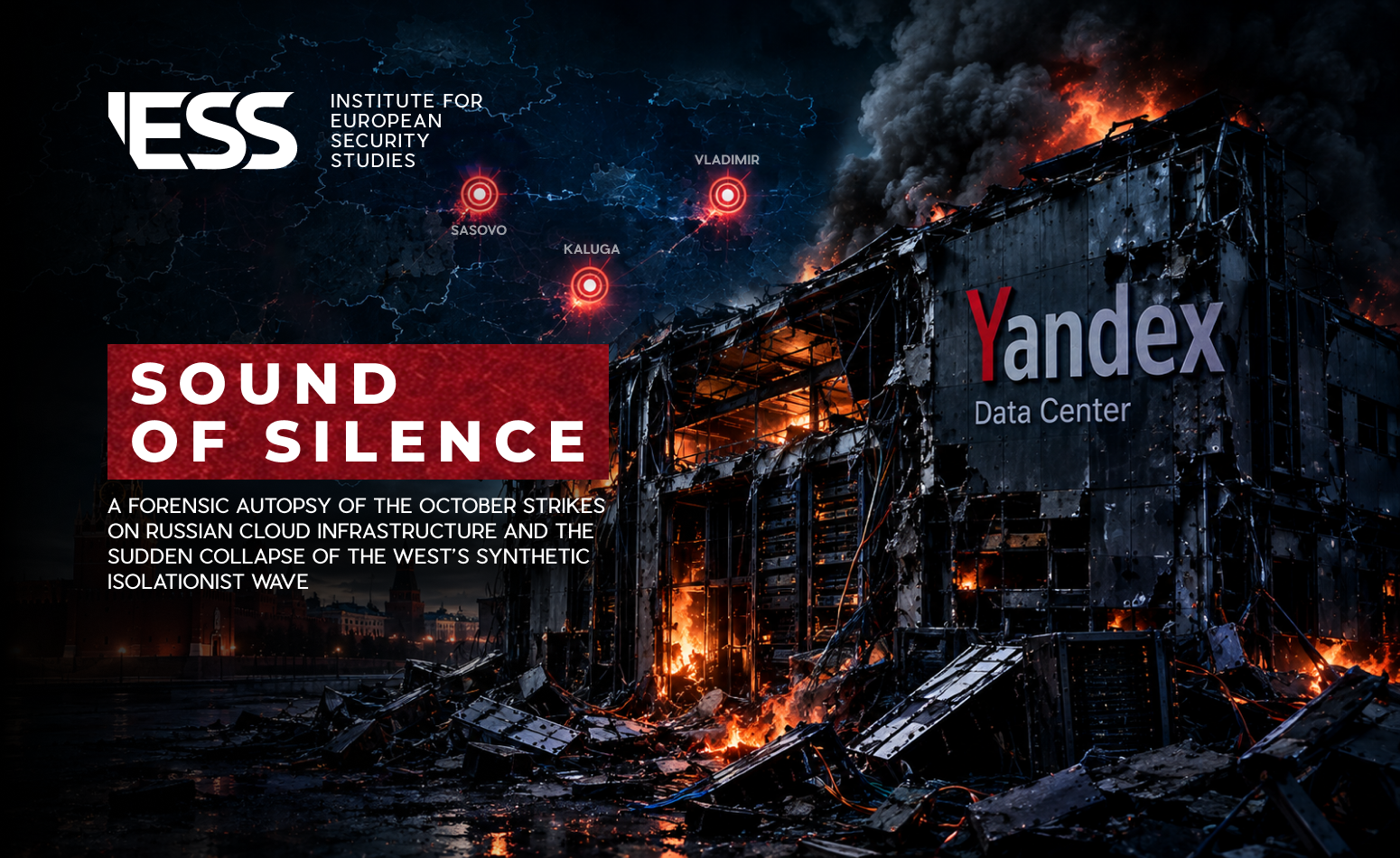
Sound of Silence
A forensic autopsy of the October strikes on Russian cloud infrastructure and the sudden collapse of the West’s synthetic isolationist wave
The most profound shift in the global information space this autumn arrived as a sudden, massive void.
Between October 8 and 11, 2026, the digital ecosystems of Western social media experienced an anomalous quiet – the relentless “chorus” of outrage simulating American workers and European citizens simply vanished.
This silence has become the aftermath of the telemetry of an amputation. Targeted physical strikes on Yandex data centers in Russia’s Sasovo, Kaluga, and Vladimir regions severed the computational brain of the Kremlin’s global influence operations, exposing the mechanical reality behind the West’s populist surge.
Hardware lobotomy
Russian intelligence operates on a two-tiered digital architecture: distribution networks of fake personas are hosted on foreign servers to evade blocking, while the cognitive engine generating localized text in real-time remains strictly inside Russia.
The October strikes systematically dismantled that engine.
By taking the Sasovo and Vladimir facilities completely offline and severely damaging Kaluga, the attacks neutralized three apex Russian supercomputers: "Chervonenkis," "Galushkin," and "Lyapunov."
This trinity provided 50.36 petaflops of performance, driven by 3,776 NVIDIA A100 GPUs, so when these servers burned, the neural networks responsible for generating millions of context-specific foreign-language posts were instantly lobotomized.
The puppet master just lost its hands.
Telemetry of a dying network
Internet infrastructure monitors captured the exact timeline of this collapse. Former US diplomat Ken Fairfax noted an instantaneous freeze in foreign bot farm activity correlating directly with the physical strikes.
Cloudflare Radar tracked the digital hemorrhaging: automated traffic from the Yandex AS13238 network dropped by 25% on October 8.
As secondary facilities were hit, the decline reached 35%, triggering a catastrophic 94% collapse on October 11. By 02:00 UTC, bot activity flatlined at a mere 0.3% of its peak level compared to the previous week.
A desperate attempt to reroute traffic later that evening only managed to claw back 11.03% of the network’s maximum capacity.
Industrial symbiosis
The Yandex blackout confirms that state-sponsored psychological operations are now seamlessly embedded into Russia’s civilian IT infrastructure: the era of Yevgeny Prigozhin’s isolated "troll factories" is over.
The scale of this symbiosis was previously mapped in the EEAS March 2026 report, which found the Russia-linked Storm-1516 network utilizing 453 distinct websites to target audiences in the US, Germany, France, and Moldova. When the Yandex cloud failed, auto-posting across this vast ecosystem froze instantly.
The Russian state apparatus has industrialized disinformation, treating civilian cloud platforms as dual-use military assets.
The Ventriloquist’s Illusion
The most damaging casualty of the server outages was the illusion of organic mass appeal.
For years, the Kremlin has artificially amplified ultra-right and isolationist communities in the West to paralyze governments and block aid to Ukraine.
The outage unmasked the ventriloquism: social media monitors reported a 94% drop in automated activity supporting the MAGA movement in the US, while automated support for the Alternative for Germany (AfD) plummeted by 56%. Without the algorithmic steroids of machine-generated likes and shares, engagement among real human users in these communities dropped by over 80%.
The perceived dominance of isolationist rhetoric on Western platforms was revealed as a synthesized mirage – millions of voices demanding the abandonment of Ukraine were, in reality, a rack of melting NVIDIA processors in Kaluga.
Hardware chokepoint
The silence of the bots is a tactical victory, but it is a temporary coma, because the architecture of Russian influence has been crippled, yet the strategic intent remains.
Crucially, the recovery of this system exposes a fatal Russian vulnerability: an absolute dependency on imported high-performance computing hardware.
Russia cannot manufacture the silicon required to rebuild the "Chervonenkis" or "Lyapunov" clusters.
Therefore, to prevent the Kremlin from resurrecting its generative AI networks, the US and EU must aggressively exploit this chokepoint by implementing strong export controls on advanced processing units and monitoring cloud service acquisitions is no longer just economic policy.
It is a matter of urgent national defense to ensure the shattered servers can never be replaced.