
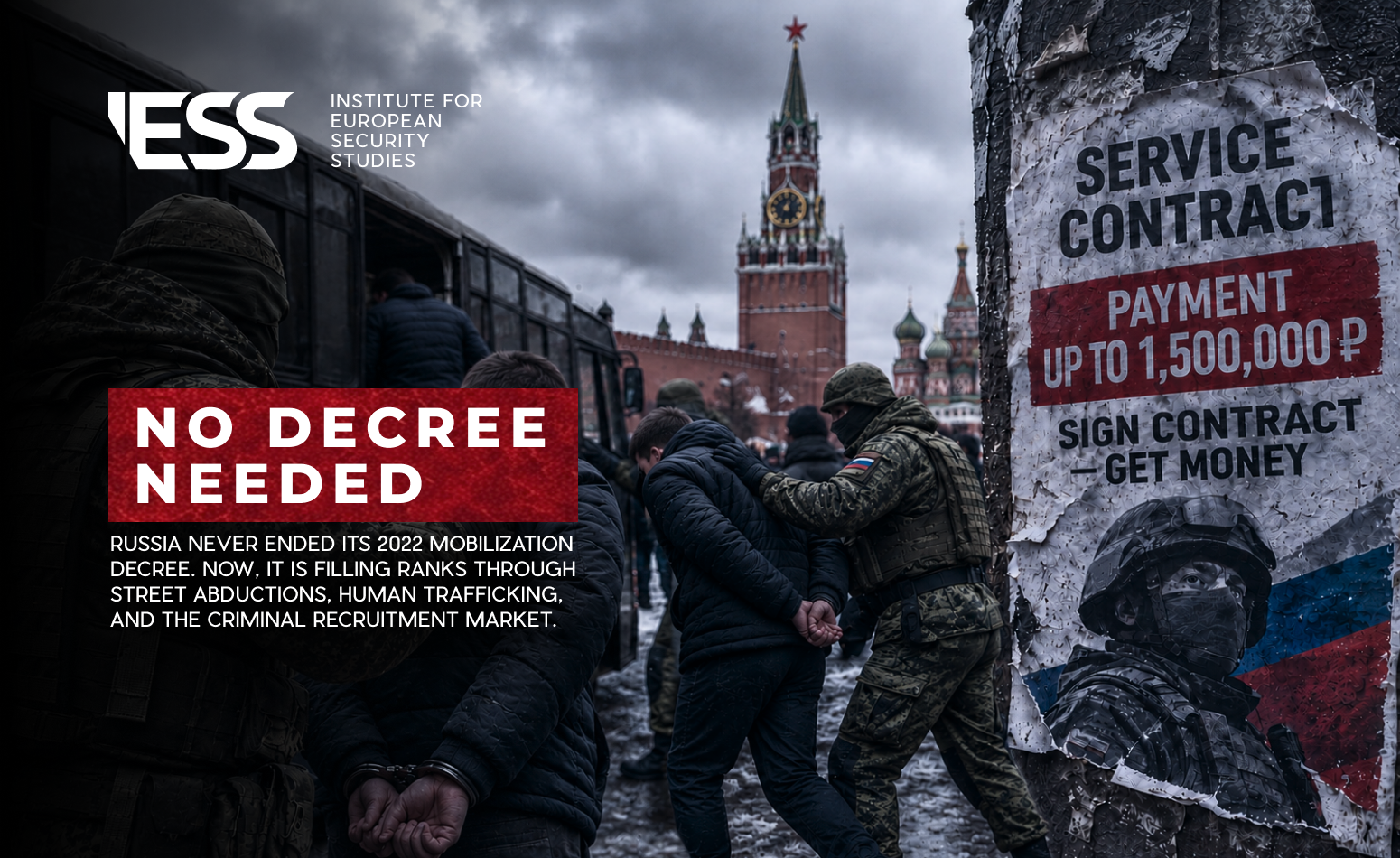
No Decree Needed
Russia never ended its 2022 mobilization decree. Now, it is filling ranks through street abductions, human trafficking, and the criminal recruitment market
More than six weeks after Russia's State Duma election handed United Russia a record 349 of 450 seats, the Kremlin still has not signed a new mobilization decree. Russian officials have made a point of saying so. Independent outlet iStories counted at least eighteen separate denials between June and mid-September alone, from Vladimir Putin, Dmitry Medvedev, Dmitry Peskov, Maria Zakharova, and UN envoy Vasily Nebenzya among others, each insisting no such plan exists.
Putin himself called the rumors "doggy nonsense" in Bishkek on September 1 and told the Eastern Economic Forum two days later that no scenario currently requires mobilization.
Every one of those denials can be technically accurate and still be beside the point. Russia's original mobilization decree, signed September 21, 2022, has never been rescinded, and Russia's own Supreme Court confirmed as recently as August 2026 that it remains legally active until Putin signs a separate order ending it.
No new decree is needed to keep mobilizing, because the old one never stopped. However, what changed is not the law, but the method.
A war that doesn't need a new decree
The legal mechanics matter because they explain why Russia can run what amounts to continuous mobilization while insisting, truthfully in a narrow sense, that nothing new has been ordered.
In August, Putin signed legislation allowing people convicted of banditry, organized criminal activity, and drug trafficking to sign military contracts, a provision Foreign Policy notes is explicitly tied to the mobilization period rather than peacetime law.
That same month, the Supreme Court cited the ongoing mobilization as an aggravating factor in upholding a five-year sentence against a Chita resident for a social media comment. Four years into the war, Russia has been legally mobilized the entire time, and no fresh signature was ever required to keep it that way.
Privatization of mobilization
What has shifted is the mechanism filling the ranks. CNN describes a quiet turn in Russia's recruitment machine: since 2022, Russia has relied mainly on large cash payments to attract volunteers, and that approach is steadily giving way to coercion and deception. Human rights coalitions tracking the trend, including Call to Conscience and the group “Idite Lesom” (Go by the Forest), recorded complaints of forced contract-signing in 17 Russian regions by late summer.
By mid-October that number had risen to 33 regions plus occupied Crimea, and the practice had reached Moscow and St. Petersburg, where roughly fifty documented incidents occurred in October alone, men detained near metro stations, apartment blocks, and public service centers, then dispatched to military units within one or two days.
The targeting follows a consistent logic: the typical target is a man from a poor, remote region, carrying debt, under investigation, or otherwise vulnerable; lawyer Artem Kliga told CNN the same pattern now runs constantly and that targets rarely know they have any right to refuse.
Russia has built a legal incentive directly into the pipeline – a law in effect since May allows debts up to 10 million rubles to be written off for anyone who signs a contract, and recruiters work from state debt registries to match targets to the offer. The breakout moment came in Penza on the night of June 17, when video showed women physically blocking a military commissariat bus carrying detained men; one woman later said her husband, who had no outstanding debts, was seized by plainclothes men, beaten, and forced to sign at the commissariat.
Criminal market for human beings
The system now runs partly on its own perverted commercial logic. Grigory Bityukov, a district prosecutor in Nizhny Tagil, Russia, told his own city council that organized crime groups, police, and military commissariat staff have entered the recruitment business, and cited a case in which three or four people delivered 330 contract soldiers, enough to staff a battalion, for a fee of 400,000 rubles per head. His proposal to end the payments was rejected.
Analyst Janis Kluge of German SWP, who tracks recruitment through regional budget disbursements, calls the arrangement "privatized coercion": the Kremlin sets quotas for each region and tolerates whatever methods regional officials and private recruiters use to fill them, keeping Moscow's own hands formally clean. By August, 56 Russian regions were paying recruiters for delivered contracts, up from 31 a year earlier, with rates ranging from 150,000 rubles in Yaroslavl to a million in Moscow and Smolensk region, and a record 1.5 million rubles in Irkutsk region for a foreign recruit.
Exporting the shortage
As the domestic pool of easily coerced men narrows, Russia has scaled up a parallel recruitment pipeline abroad. Ukrainian military intelligence has identified 45,959 foreign nationals from 151 countries who signed contracts with the Russian army, including 5,451 from African states. Recruitment from Burundi jumped to 699 people in the first nine months of 2026 from just 30 in all of 2025; Zimbabwe's total rose to 530 from 65.
Amnesty International described the pattern in September as human trafficking: fake job postings, contracts in languages recruits cannot read, confiscated passports, and roughly two weeks of preparation before deployment to the front. Of 15 captured foreign recruits Amnesty interviewed, only 3 understood they were going to fight. Radio Liberty traced one group of more than 30 Bangladeshi men who themselves paid intermediaries roughly $8,000 each, expecting construction work; Bangladeshi police have confirmed at least 20 deaths, 17 of them killed by drones on their first day at the front.
Kenya's government has identified 354 of its own citizens drawn into the war, at least 84 dead or missing, and its foreign minister traveled to Moscow this spring to protest directly.
A system that cannot keep pace
None of this is translating into a growing army. Kluge's tracking shows Russia signed 263,000 new contracts between January and September 2026, down from 292,000 over the same period in 2025, even as the average cost per contract rose nearly 30% to 1.9 million rubles. September's pace of roughly 30,000 new contracts a month, if it holds, would leave the Kremlin with around 350,000 recruits for the year against an internal target of 409,000, a shortfall approaching 60,000.
Against that, Ukraine's General Staff reported Russian losses exceeding 46,000 in September and more than 54,000 in October, figures the Institute for the Study of War says now outpace recruitment by roughly 1,000 people a month. Regional budgets are buckling under the strain: St. Petersburg, one of Russia's wealthiest regions, cut its contract payment from 3.5 million to 1 million rubles in mid-October, then to 400,000 rubles days later, while trimming 70 billion rubles from its own spending.
Russia's projected 2026 federal deficit stands at 7.3 trillion rubles, roughly 3.2% of GDP and double the original plan, even as 2027's defense budget is already set at 17.1 trillion rubles, 35% of total state spending.
Closed border
The most consequential part of this system has nothing to do with recruitment at all. Russia's electronic summons registry can now block a man from leaving the country automatically, seven days after a digital summons is logged against his name, whether or not he has seen it, and the database is synchronized with Belarus, closing the overland route that let hundreds of thousands escape in 2022.
On September 2, a 24-year-old reservist was turned away at Krasnodar airport over a registry flag, the first confirmed case of the system blocking a reservist rather than a draft-age conscript. Ukrainian military intelligence assesses that Russia's armed forces could absorb 300,000 to 500,000 newly mobilized men simultaneously, though a BBC analysis notes the army would still need at least 40,000 additional commanders, at an estimated annual cost of 720 billion rubles, to actually use them.
What Europe should take from this
There’s a temptation in Europe to read the absence of a formal mobilization announcement as evidence of Kremlin restraint, or even of weakening resolve. The system described above argues against that reading on every count.
However.
Russia has not stepped back from mobilization – instead, it has moved mobilization out of public view, into vans with tinted windows and criminal fee schedules, precisely because the September 2022 decree already gave it the legal authority to do so without ever asking the public's permission again. A government that needs to recommit publicly to this war would have signed a new decree. A government confident enough to run the equivalent of mobilization through street abductions, debt bribes, and trafficked foreign labor is one that has concluded it does not need to ask.
At the same time, the strain is real, and that matters just as much for how Europe should read the coming months. A recruitment pace falling behind record losses, regional budgets cutting payments twice in a week, and a population where 64% now tell Levada Center pollsters they favor negotiations over continued fighting all describe a war machine running on diminishing returns rather than reserve strength.
The infrastructure that Russia has built:
- automatic summons registry,
- Belarus-linked border database,
- rewards for criminals for bringing fresh recruits to sign “volunteer” contracts,
- expanded army staffing numbers Putin has approved four times this year;
This all exists for a single purpose: to delay a large, open mobilization wave.
European governments should treat that infrastructure as the actual signal of ongoing, not future, mobilization in Russia. A direct threat not only to Ukraine, but to European security as a whole.