
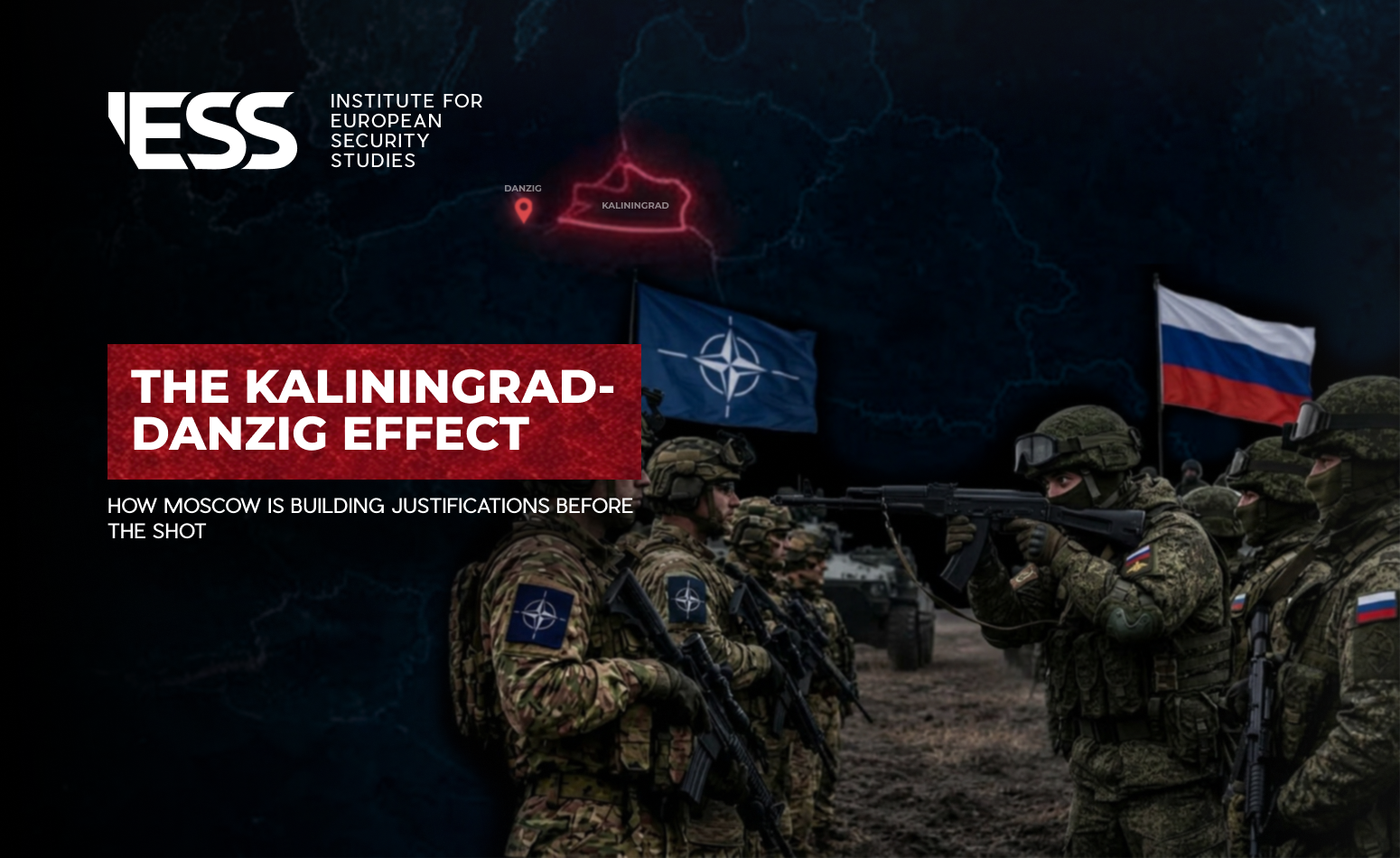
The Kaliningrad-Danzig Effect
How Moscow is building justifications before the shot
Moscow has spent recent weeks making diplomatic noise about Kaliningrad, framing NATO activity near the exclave as a threat it may eventually have to answer with force.
Taken on its own, that sounds like ordinary saber-rattling. Set against the calendar, it looks more familiar than that: in December 2021, Russia issued a set of demands dressed up as "security guarantee" proposals, insisting it was the party under threat and simply seeking reassurance. Two months later came the full-scale invasion of Ukraine.
The pattern isn't subtle once you've seen it once, and IESS sees no reason to assume Kaliningrad is an exception rather than a repeat performance aimed at a different stretch of map.
Writing the alibi before the act
What makes this kind of rhetoric useful to the Kremlin isn't that anyone outside Russia believes it. It's that it gets said early, repeatedly, and on the record, so that whatever comes next can be framed as a response rather than an initiation.
NATO exercises, the detention of tankers Moscow considers part of its shadow fleet, and ordinary Western discussion of how to defend the Baltic states can all be folded into the same narrative: the West provoked this, Russia doesn`t even reacted.
Once that framing is in place, the actual sequence of events stops mattering very much. Any future Russian move against the region, however aggressive, arrives pre-packaged as self-defense for an audience that was never going to check the timeline closely anyway.
Kaliningrad, the useful exclave
Kaliningrad is particularly well suited to this role because it genuinely is encircled by NATO territory, which lets Moscow dress a manufactured grievance in a kernel of geographic truth. Statements about Russia's readiness to use "all available means" if the exclave were attacked raise the temperature in the Baltic region without requiring any actual change in the military situation on the ground.
That caveat matters: we draw a hard line between a real military threat, a hypothetical defense scenario Moscow is simply narrating out loud, and a bare informational claim with no independent verification behind it. Kaliningrad rhetoric currently sits mostly in the second and third categories. The point of raising it this often is to make audiences stop asking which category it belongs to.
Nuclear arithmetic, selectively compared
The nuclear dimension is where the rhetoric sharpens from background noise into deliberate intimidation.
Russian officials have been explicit about including their nuclear arsenal among the country's strategic advantages in any confrontation with European states, and Russian commentary has taken to comparing Russia's nuclear stockpile favorably against the combined arsenals of Britain and France specifically. That comparison is carefully incomplete.
It leaves out the rest of NATO's nuclear umbrella, the American one, entirely, because including it would undercut the entire point of the exercise. The goal isn't an honest assessment of the strategic balance.
Therefore, it's raising the perceived political cost of any European military response high enough that European governments start negotiating with themselves before Moscow has to negotiate with anyone.
The same umbrella Minsk already wears
None of this is happening in isolation, and we have already mapped the pattern it belongs to.
In Shadow of the Vanguard article, we documented how Russia's transfer of tactical nuclear weapons to Belarus created a deliberate zone of impunity, one that lets Minsk host the drone relay stations guiding Russian strikes toward the Polish and Lithuanian border, violate NATO airspace, and run aggressive military exercises along the frontier, all on the calculation that NATO will self-deter rather than risk a nuclear-adjacent confrontation.
Kaliningrad rhetoric is the same logic running in the other direction: instead of exporting a nuclear shield to a proxy state to cover hybrid operations at arm's length, Moscow is invoking its own arsenal directly, over its own most exposed piece of territory, sitting at the opposite anchor of the same Suwałki Gap that makes the Belarus-Lithuania-Poland border so strategically sensitive in the first place.
A rehearsal with the infrastructure already visible
The informational layer doesn't stand alone either: in Baltic vector analysis, we tracked the physical side of the same preparation: the Russian Ministry of Defense's push to secure 16,000 to 20,000 additional hospital beds in the Northwestern Federal District, under the reconstituted Leningrad Military District that borders the Baltic states directly, alongside Lithuanian intelligence reporting that Moscow is exploring the use of captured Ukrainian drones for false-flag strikes on Baltic infrastructure.
CIA Director John Ratcliffe's unannounced trip to Moscow at the end of August, delivering the same category of warning his predecessor William Burns gave Putin in late 2021, is itself a signal that Washington reads these indicators as seriously as it read the ones in front of Ukraine five years ago.
Kaliningrad's nuclear rhetoric is best understood as the vocal half of a preparation IESS has already highlighted has a physical half as well, two layers of the same campaign rather than two separate stories.
What actually needs watching
None of this amounts to proof that Moscow has decided to attack a NATO member, and IESS isn't claiming otherwise.
As we analyzed in Russia's next war, the Kremlin's strategy runs through probing red lines and normalizing new thresholds of acceptable violence well before any conventional attack, and public rhetoric is only one input among several that need to be weighed against intelligence reporting, troop movements, and other concrete indicators before anyone draws conclusions about actual intent.
What the rhetoric reliably does, regardless of whether an attack ever materializes, is generate exactly the kind of uncertainty that complicates a fast, unified allied response. If European capitals spend the critical early hours of any future incident arguing over whether Russia's nuclear signaling makes a forceful reply too dangerous to attempt, Moscow will have won the only contest it was actually trying to win with this rhetoric in the first place.
The task in front of European security planners isn't to prove or disprove that Russia intends to attack the Baltics on any particular timeline, but to make sure that Kaliningrad's nuclear noise never gets the chance to paralyze a collective decision the alliance would otherwise be fully capable of making.
Just like Belarus's nuclear shield did before it.