
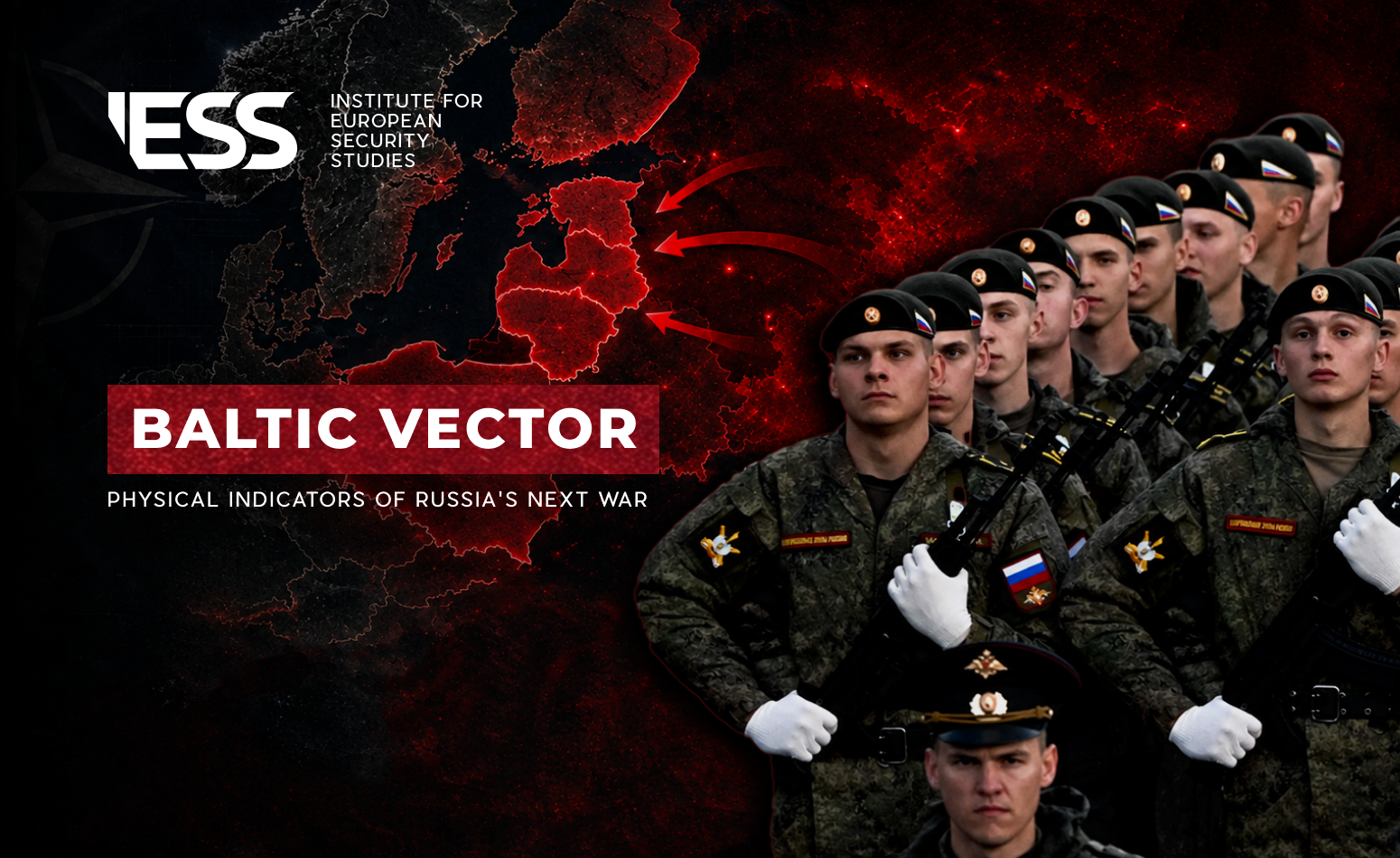
Baltic vector
Physical indicators of Russia's next war
In our previous strategic assessment, Russia's next war, IESS established that a direct military confrontation between the Russian Federation and a united Europe requires the preliminary political and social dismantling of European solidarity.
However, cognitive warfare and informational subversion are only the preparatory phases of a broader kinetic strategy. Recent developments in the late summer and early autumn of 2026 indicate that the theoretical framework of this future conflict is rapidly acquiring a physical dimension.
A convergence of intelligence reports, diplomatic anomalies, and logistical movements suggests that Moscow is systematically preparing the infrastructure for potential escalation, with the Baltic states emerging as the primary vector for testing the borders of the NATO Alliance.
The logistics of blood and the Leningrad Military District
The most alarming indicators of impending military aggression are rarely found in political rhetoric; they are hidden in military logistics and medical infrastructure. Throughout the autumn of 2026, the Russian Ministry of Defense initiated a massive repurposing of civilian medical facilities, planning to secure between 16,000 and 20,000 additional beds in hospitals primarily within the Northwestern Federal District.
This region directly borders the Baltic states and falls under the operational responsibility of the newly reconstituted Leningrad Military District.
The systematic strengthening of this specific military district signals a definitive shift in Moscow's strategic posture. The current military hospital capacity in Russia, which exceeds 58,000 beds, is already strained by the high casualty rates of the Ukrainian front. The urgent, large-scale expansion of medical infrastructure in the northwest, complete with the establishment of field hospitals and massive blood reserves, is a classic pre-war indicator.
It perfectly mirrors the logistical preparations observed in late 2021 and early 2022, immediately prior to the full-scale invasion of Ukraine.
Hybrid pretexts and false flags
While conventional infrastructure is being prepared, Russian intelligence services are simultaneously designing mechanisms to strike NATO territory while maintaining plausible deniability.
According to Lithuanian military intelligence and defense officials, Moscow is actively exploring the use of captured Ukrainian-manufactured drones to conduct strikes against critical infrastructure in the Baltic states.
This represents a sophisticated evolution of the false flag operation. By utilizing Ukrainian aerial assets intercepted on the eastern front, Russia aims to create operational confusion, explicitly designed to paralyze NATO’s collective decision-making process.
The objective is to inflict kinetic damage and test the Alliance's threshold for activating Article 5, all while shielding Moscow from direct attribution and avoiding an immediate, unified conventional response from the West.
The diplomatic echoes of 2021
The gravity of these physical and hybrid preparations has triggered the highest levels of international alarm, leading to unprecedented diplomatic interventions. At the end of August 2026, CIA Director John Ratcliffe made an unannounced, clandestine visit to Moscow.
During closed-door negotiations, he delivered a direct warning to Russian intelligence chiefs against any actions that could lead to military escalation against NATO allies, specifically highlighting the Baltic states.
This secret mission carries immense historical weight, functioning as a direct parallel to the actions of his predecessor, William Burns, who traveled to Moscow in late 2021 to warn Vladimir Putin against invading Ukraine.
The deployment of the CIA Director for such a specific deterrent message confirms that Washington’s intelligence apparatus is registering the same critical threat indicators on the Baltic border today as it did on the Ukrainian border five years ago.
The regional response and the Ukrainian warning
The frontline states of Eastern Europe are acutely aware that bureaucratic delays within the Alliance could be fatal in the event of a rapid Russian offensive. Ukrainian military leadership, possessing the most relevant combat experience against the Russian army, has issued stark warnings.
Head of the PO Kyrylo Budanov, and the Commander of the Unmanned Systems Forces Robert Brovdi have explicitly warned NATO that Russia envisions a blitzkrieg scenario for the Baltics, attempting to achieve in Vilnius, Riga, and Tallinn what it failed to do in Kyiv in "three days."
Budanov emphasized during his visit to Riga that only highly capable domestic armies, prepared for immediate combat, can effectively deter Russian aggression in the initial hours of a conflict.
This reality has forced regional powers to adopt a more aggressive deterrence posture outside the rigid framework of NATO bureaucracy. Poland has publicly signaled its readiness to intervene militarily to defend Lithuania, Latvia, and Estonia on a bilateral basis, without waiting for the formal activation of Article 5 procedures.
This political stance is deeply rooted in public consensus, with nearly 80 percent of Polish citizens supporting immediate military aid to their Baltic neighbors in the event of a Russian attack.
The convergence of these factors – the restructuring of the Leningrad Military District, the mass mobilization of medical logistics, the planning of false-flag drone strikes, and the desperate diplomatic interventions from Washington – paints a clear strategic picture.
The Kremlin is no longer just conceptualizing its next war: Russia is actively building the infrastructure to wage it. The Baltic vector is systematically being prepared as the ultimate testing ground for the resilience of the Western security architecture, after Ukraine had become patient zero of modern Russian imperial virus.