
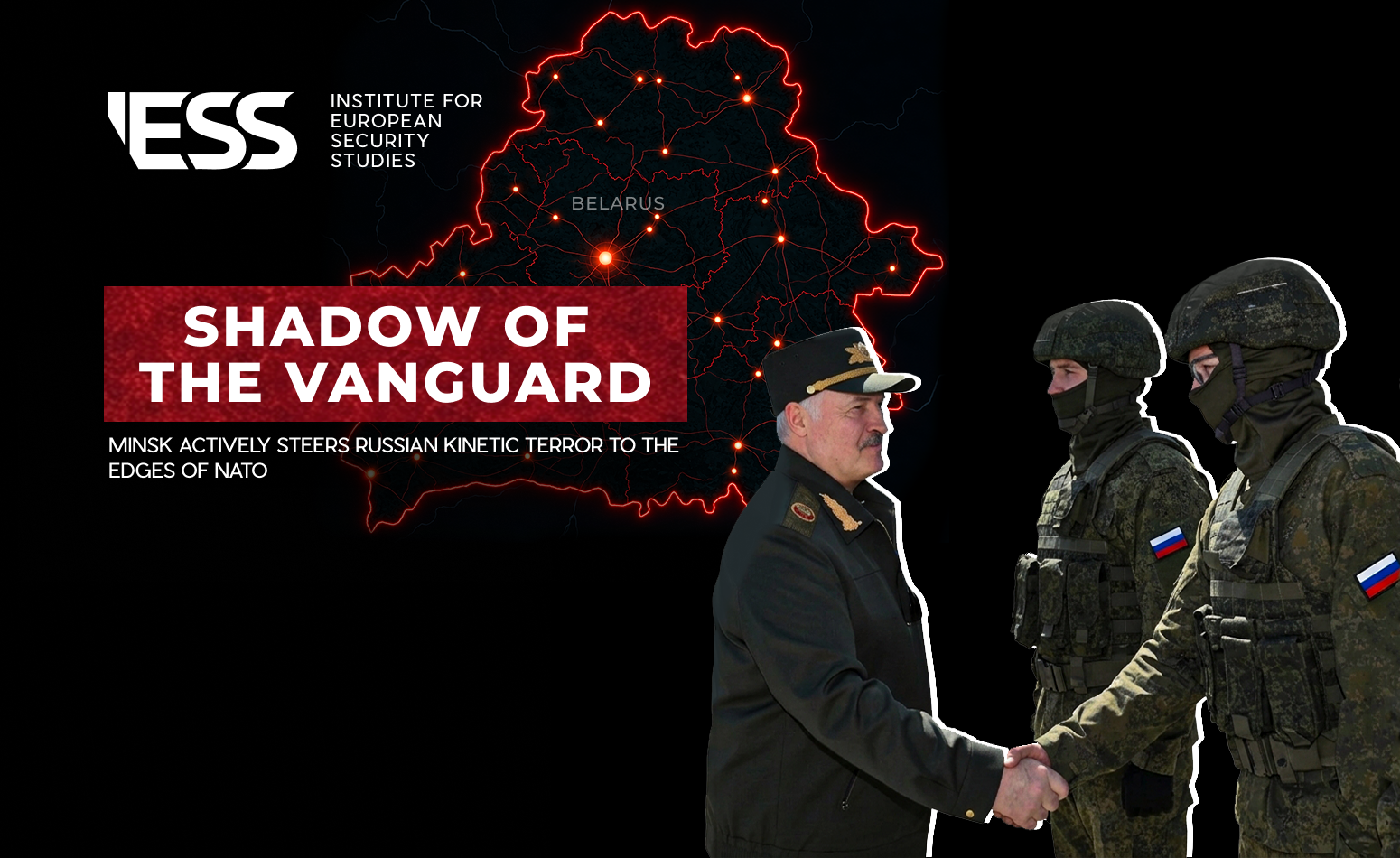
Shadow of the Vanguard
Minsk actively steers Russian kinetic terror to the edges of NATO
The facade of Belarusian non-participation in the kinetic phase of the war has been completely and irreversibly eroded. Minsk has officially transitioned from a passive logistical staging ground for the Russian military into an active, technological accomplice, deliberately engineering direct strikes on the very threshold of the NATO Alliance.
The recent military maneuvers through 15-18 of September and cross-border incidents involving Belarusian territory are not isolated events or routine training exercises anymore. Rather, they represent a calculated escalation, demonstrating how the Kremlin is weaponizing its vassal state to project violence and psychological terror directly against the Eastern European security architecture.
The relay network and the strike on Yahodyn
The undeniable proof of this active complicity materialized during the brazen Russian drone strike on the Yahodyn railway station in the Volyn region. Striking a civilian locomotive just kilometers from the Polish border, the attack carried profound geopolitical weight. It occurred in chilling proximity to high-level international transit, striking shortly after a diplomatic train carrying former UK Prime Minister Boris Johnson had passed, and while another train transporting former CIA Director David Petraeus was physically present at the station.
This was not a stray munition or a navigational error; it was a calibrated message of intimidation delivered directly to the West.
What elevates this incident from a tragic frontier strike to a coordinated regional escalation is the technological infrastructure that made it possible. According to Ukrainian border and intelligence officials, this attack, along with a broader surge of UAV incursions across the western regions of Rivne, Volyn, and Lviv, was directly facilitated by signal relay stations operating on Belarusian territory.
By activating these relays, Minsk amplifies and stabilizes the navigation systems of Russian Shaheds and jet-powered drones, artificially extending their lethal reach.
Therefore, Belarus is actively providing the electronic guidance necessary to drop Russian explosives within a two-kilometer radius of NATO territory.
Bound by shared guilt
The integration of Belarusian military infrastructure into the Russian strike complex is not an administrative accident; it is the ultimate realization of the geopolitical dynamic we explored in Tied in blood material back in June.
The Kremlin has systematically and deliberately bound the Belarusian leadership through shared war crimes and mutual complicity. By forcing Minsk to act as an active participant in cross-border terror – hosting the very relay stations that guide drones into civilian targets – Moscow ensures that Alexander Lukashenko has no geopolitical exit strategy and no path to independent normalization with the West.
The Belarusian regime is now inextricably linked to the outcomes of Russian aggression, ensuring absolute loyalty through the guarantee of shared international prosecution.
Operating under the zone of impunity
Against this backdrop of cross-border technological terror, the command and staff exercises initiated by the Belarusian Ministry of Defense from September 15 to 18 assume a distinctly hostile character. Staged at the Gozha, Brest, and Ruzhany training grounds, these maneuvers are actively weaponized to artificially inflate the regional threat level, basically flanking the borders of Lithuania and Poland.
So how does a smaller state dare to provoke the world's strongest military alliance so openly? The answer lies in the strategic umbrella we explored in Nuclear shield of aggression article from May.
The highly publicized transfer of Russian tactical nuclear weapons to Belarus was never purely about defensive deterrence; it was designed to create a proactive zone of impunity. This nuclear shield allows Minsk to host drone relay stations, violate airspace, and conduct aggressive military exercises right on the borders of Poland and Lithuania, calculating that NATO will be self-deterred from a kinetic response out of fear of nuclear escalation.
In the end, this nuclear umbrella provides the operational cover required to wage hybrid and conventional terror below the threshold of total war.
The NATO response and the shifting paradigm
The reality of combat drones being electronically steered through Belarusian airspace to strike NATO's immediate periphery has forced neighboring states to fundamentally recalibrate their security posture. Acknowledging this shifting paradigm, Poland has rapidly scaled up the protection of its Ukrainian border checkpoints, deploying specialized engineering units to fortify critical logistical arteries.
Furthermore, the gravity of the intertwined Russian-Belarusian escalation prompted Polish President Karol Nawrocki to convene an emergency national security council with his Defense Minister and Chief of the General Staff on September 18, transitioning Warsaw’s response from passive observation to systemic counter-mobilization.
As we established in our broader strategic assessment, Russia's next war, Moscow continuously probes the West's red lines to normalize new thresholds of violence.
By utilizing Belarus as a technological proxy to project kinetic power directly into the Alliance's borderlands, the Kremlin is testing exactly how much collateral risk Europe will tolerate before invoking a collective response.
While international legal frameworks may still debate the physical absence of Belarusian infantry on Ukrainian soil, the operational reality dictates otherwise.
Shielded by Russian nuclear warheads and tied by shared blood, Minsk is acting as the Kremlin's manual aggressor, willfully participating in the violent destabilization of the entire European continent.