
Accelerant
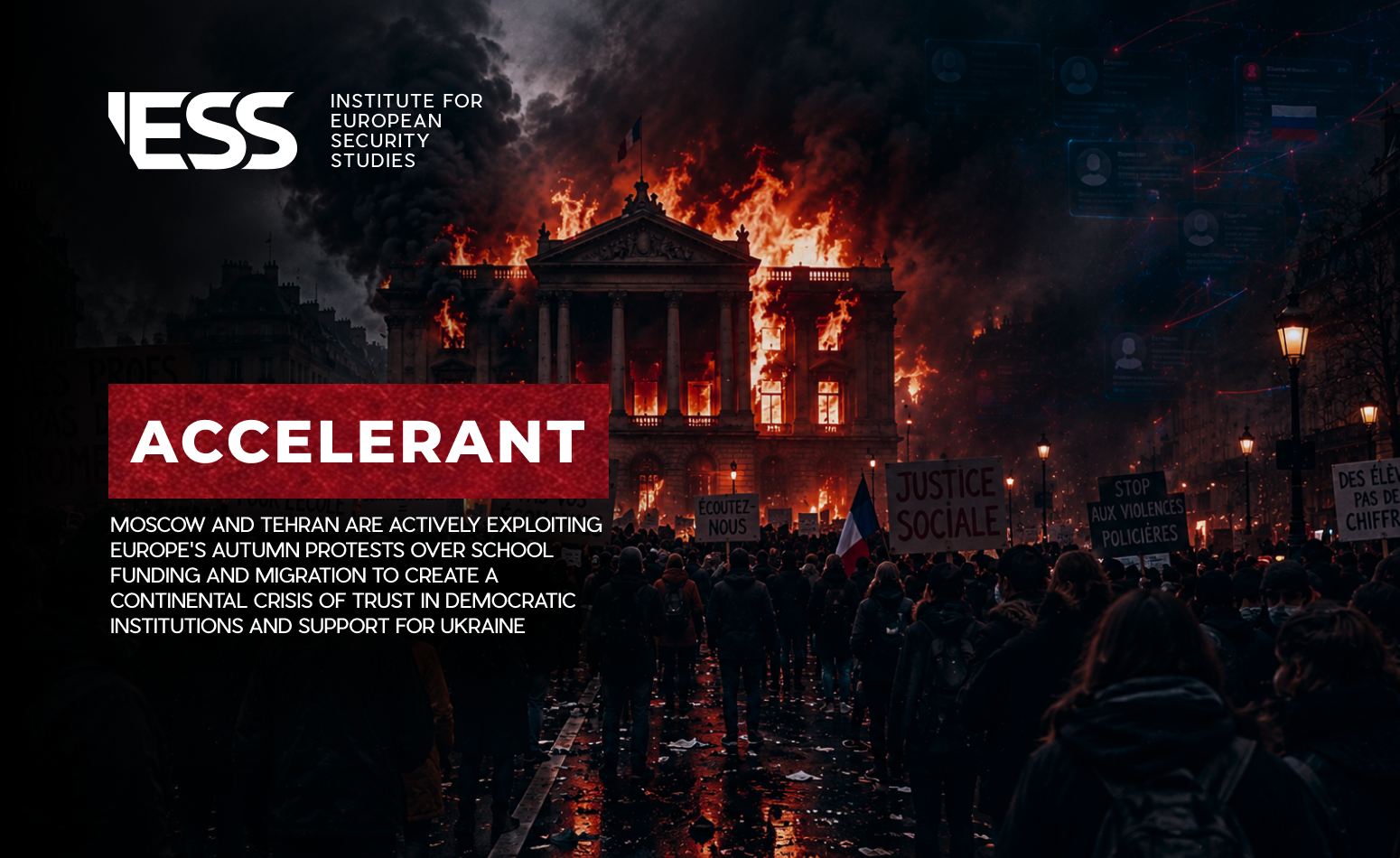
Moscow and Tehran are actively exploiting Europe's autumn protests over school funding and migration to create a continental crisis of trust in democratic institutions and support for Ukraine
A fire badly damaged the city hall of Limoges during the unrest in mid-October, a building that has stood since 1883. Nobody has produced evidence that Russian hands lit it, and this we do not suggest otherwise.
What deserves scrutiny is what happens to such an image once it leaves the town. Within hours, a burning municipal building in France becomes useful material for any government that would like Europe to look ungovernable.
Fire investigators distinguish between the ignition source (how a blaze began) and the accelerant (why it spread faster than anyone could contain it); Europe's autumn of unrest has these two distinct layers, and misinterpreting their relationship leads to flawed responses.
Ignition is domestic
The French wave began on 18 September in Créteil, a suburb of Paris, where lycée students protested teacher shortages and failing school buildings. Within days it had reached hundreds of schools.
The leading education unions joined in, asking for more money for public lycées and better conditions for teaching, while students blocked roads and barricaded their own buildings. Wages and the cost of living soon joined the list of demands. By 17 and 18 October the movement had the backing of major unions and of the opposition left party La France Insoumise, and crowds in the hundreds of thousands filled the streets, with estimates running from about 550,000 (the Interior Ministry) to 800,000 (the organizers).
Part of it turned violent. Shops were looted in Bordeaux and Marseille, and Reuters counted more than 2,000 arrests by 17 October.
These events stem entirely from domestic factors.
Underfunded schools are an argument French voters are entitled to have with their own government, and the early weeks of the movement should be read as exactly that. France's agency for tracking foreign digital interference, VIGINUM, reported at the end of September that it saw no sign of artificial amplification by outside actors at that stage.
The distinction matters, because the rest of this story only holds if the protest and the exploitation of the protest are kept apart.
Where the accelerant arrives
The picture changed as the crowds grew. On 7 October Paris summoned Iran's ambassador after the Iranian foreign ministry's official accounts accused France of brutality against demonstrators and of large-scale, gross human rights violations. France called it a disinformation campaign and said that false content spread through a foreign ministry's own channels was unacceptable.
Six days later, speaking at an OECD conference, Foreign Minister Jean-Noël Barrot went further and named Russia, China and Iran as actors using the schoolchildren's protests to push hostile narratives. Foreign accounts, he said, were using social networks to inflame disputes over migration, religion and world events, deepen political polarization and destabilize France ahead of its 2027 presidential election.
The content these operations push has a recognizable shape. Governments have lost control. Support for Ukraine is being paid for by ordinary citizens. Sanctions on Russia explain the cost of living. The country is a few steps from civil war. No single claim has to convince anyone.
Stacked up, they sketch a state that has stopped functioning and a European project that cannot protect its own people, which is the impression these operations exist to create.
By mid-October the unrest had also crossed borders, as youth organizations in Italy, Belgium and other countries staged "solidarity actions," turning a French dispute over lycée budgets into a continental talking point.
Two audiences, one message
Migration is the most reliable fuel.
IESS assessment is that Moscow works both sides of that fault line at once, pushing messages that feed fear of migrants among some audiences while pushing others that deepen distrust of the police and the state among the communities that feel targeted.
The channels are the familiar ones: outlets under Kremlin control, anonymous Telegram channels and networks of fake accounts. The raw material is whatever incident has already gone viral, particularly one involving migrants, which can be recycled as proof for either side. The operators do not need to pick a camp. They need each camp to conclude that the state has sided against it.
That is why the damage is easy to underestimate – a single post is crude and forgettable. A season of them, arriving through different accounts to different communities, teaches millions of people to read the same events as evidence of betrayal.
The main goal is to weaken the instinct to trust public institutions to arbitrate disputes.
A playbook with a record
None of this is new, which is the strongest argument against treating it as an episode. In December 2018, at the height of the Yellow Vests movement, French authorities opened an inquiry into roughly 600 social-media accounts linked to Russia that were pushing disinformation under the #giletsjaunes hashtag, among other things the claim that France was a deeply divided country on the edge of civil war.
The same line is back in similar form: Britain offers an older example. On 12 October Prime Minister Andy Burnham confirmed that Russia interfered in the 2016 Brexit referendum, and warned that the same kind of activity is under way in France and Germany today.
A 2020 report by Parliament's Intelligence and Security Committee had already warned of sustained Russian influence efforts in British politics. What changes between 2016, 2018 and 2026 is the speed and the number of platforms. The method, a real grievance amplified into a crisis of confidence, does not.
When the street and the ballot box agree
The better test of an influence campaign is whether it still needs its operators.
In early October the parliament of Saxony-Anhalt, with the votes of the Alternative for Germany and the Sahra Wagenknecht Alliance, adopted a resolution calling for an end to military and financial support for Ukraine and for the lifting of sanctions on Russia. The two parties share almost nothing else. One is a hard-right nationalist force, the other a left-populist alliance, and yet they converged on a text the Kremlin could have drafted itself.
Whether or not Moscow had a hand in the drafting, and nothing public says it did, the outcome is the one such campaigns are built to produce: a Russian policy objective arriving in a European legislature in local ideological dress.
The same logic explains the direction of travel. If the pattern holds, Germany, which Burnham named in his warning, and Britain itself are the logical next theaters. Both are among Ukraine's most consistent backers, and a wave of destabilization moving toward them aligns with a campaign aimed directly at weakening the coalition of governments supporting Ukraine.
An accelerant with a supply chain
Ukrainian strikes on Yandex data centers in Russia temporarily disrupted parts of the country's digital infrastructure, and the aftermath showed up in the metrics analysts use to spot coordinated campaigns: automated traffic fell by 99.6 percent, and the activity of certain networks of inauthentic accounts by 83.6 percent.
The figures are a reminder that influence operations have physical dependencies, servers and power among them, and that what looks like a spontaneous wave of outrage can run on a handful of buildings.
Viewing this as a complete solution would be a mistake. The disruption was temporary, while Moscow maintains a persistent interest in a politically chaotic Europe.
The servers will be rebuilt, and the next surge will arrive on infrastructure designed to survive the last one. While Ukraine can damage the physical machine, Europe must focus on making its public resilient to manipulation.
Firebreaks, not blame
What follows from this is a discipline European governments have struggled to keep. The protest is a domestic fact, and the amplification is a foreign one. Treating every demonstrator as a Russian asset hands the Kremlin its best line, that Europe's leaders despise their own citizens. Ignoring the amplification lets the operators write the story of the crisis while the government is still arguing about its budget.
The French response suggests what a workable middle looks like. Paris answered quickly and specifically, summoning an ambassador and naming three states in public. That sequence needs to become standard: fast attribution aimed at the accelerant, and real policy aimed at the grievance.
France votes for a president in 2027, and every contested campaign season between now and then is another chance to run the same exercise.
So it`s crucial to every European government to repair its schools and expose those feeding the fire to strengthen its resilience against external destabilization.