

The Sixteen-Hectare Graveyard
Leaked civil registry databases from Rosstat confirm at least 450,100 Russian war deaths and expose how the Kremlin stretches death certificate registration across twelve months to disguise a half-million mortality crisis
When the pro-Ukrainian hacker group Silent Crow and the Belarusian Cyber Partisans breached the central IT infrastructure of Russia's Federal State Statistics Service (Rosstat) between October 29 and November 1, 2026, they did more than paralyze 25,000 agency workstations and force Moscow to delay its macroeconomic reporting.
During six months of quiet persistence inside Rosstat's internal networks and virtualization systems, the attackers exfiltrated 23 terabytes of state data, including two terabytes of "For Official Use Only" (DSP) files and the master databases of the agency's "Demography" and civil registry systems.
The centerpiece of the leak is a complete extract of Russian medical death certificates (Form MSS) spanning from February 2022 through August 28, 2026. Stripped of Kremlin spin, the state's own mortality ledger records 450,100 Russians killed in the war against Ukraine.
Measured against the 73,080 square kilometers of Ukrainian territory Russia has seized since February 2022, the Kremlin has traded 6.2 dead citizens for every single square kilometer of land, or one Russian life for every 16 hectares.
Seven layers of the morgue ledger
Unlike open-source tallies by Mediazona and the BBC, which had verified 285,881 names from public obituaries and graveyards by early November, the Rosstat extract captures the internal bureaucratic reality of the Russian state. Every time a Russian citizen dies and a family claims a burial allowance or military death payout, a medical certificate of death must pass through the civil registry into Rosstat's database.
Because a single death record undergoes an average of 2.55 administrative revisions, the leaked database was deduplicated by individual certificate records rather than raw table rows, eliminating any possibility of double counting.
To hide the scale of military mortality inside general demographic tables, Russian registrars distribute war deaths across seven distinct documentary categories and one uncoded statistical buffer:
- 356,056 deaths explicitly carry ICD-10 medical code Y36 ("Operations of war") in at least one of the ten diagnostic fields of the death certificate.
- 38,229 deaths are logged under code Y89.1 ("Sequelae of war operations") or feature explicit combat wording in the medical text without a standardized code – a category heavily populated by soldiers who died in rear hospitals months after sustaining frontline wounds.
- 18,291 deaths carry no diagnostic cause code at all, but have the administrative checkbox "Died in military operations" marked on the form.
- 575 deaths are classified under the "Terrorist act" certificate field, a bureaucratic euphemism routinely applied to cross-border strikes and partisan operations.
- 13,671 deaths involve Russian citizens registered in domestic civil registries whose place of death is listed in occupied Ukrainian territories, with the cause-of-death line left completely blank.
- 14,160 deaths represent documented non-combat fatalities of active-duty service members, capturing the epidemic of suicides, alcohol poisonings, disease, and military road accidents inside training camps and rear garrisons.
- 9,118 deaths are extracted from front-line and rear records missing a stated cause, calculated from the anomalous statistical spike of working-age men dying in border and occupied zones compared to baseline male mortality of 50.5%.
Even this 450,100 total omits three massive categories of Russian battlefield casualties: soldiers declared "missing in action" whose bodies remain in Ukrainian soil, foreign mercenaries recruited from 151 countries whose deaths never enter Russian civil registries, and mobilized residents of occupied Donetsk and Luhansk documented outside the federal system.
Bureaucratic time-release and the missing 54,000
The most significant intelligence insight inside the Rosstat leak is not the static number of dead, but the way the Russian state slows down paper flow to manufacture the illusion of declining casualties. If an analyst looks strictly at the "Date of Death" field in the Rosstat register for 2026, the war appears to be winding down: only 3,751 deaths are listed for June 2026, 1,743 for July, and 1,244 for August.
That drop is a bureaucratic mirage created by registration lag. By tracking the exact timestamp when each certificate entered the federal database against the actual date of death on matured cohorts from 9 to 15 months ago, the dataset exposes a deliberate slowdown in state processing.
In early 2024, 46% of military deaths were registered in Rosstat within 30 days of a soldier's death. By late 2025 and 2026, only 21% to 22% of deaths reach the database within the first month, 38% after 90 days, 61% after six months, and 100% only after a full 365 days. Furthermore, a fifth of all new records arriving in 2026 have the date of death omitted entirely.
When measured by the month a record arrives in the database, the Kremlin's war machine is experiencing an unprecedented surge in casualties. As illustrated in Graph 2 (Russia’s Rising War Deaths), registered deaths climbed exponentially from 18,877 in 2022 (+124.4% YoY into 2023 at 42,365) to 109,683 in 2024 (+158.9% YoY) and reached 182,264 in 2025 (+66.2% YoY).
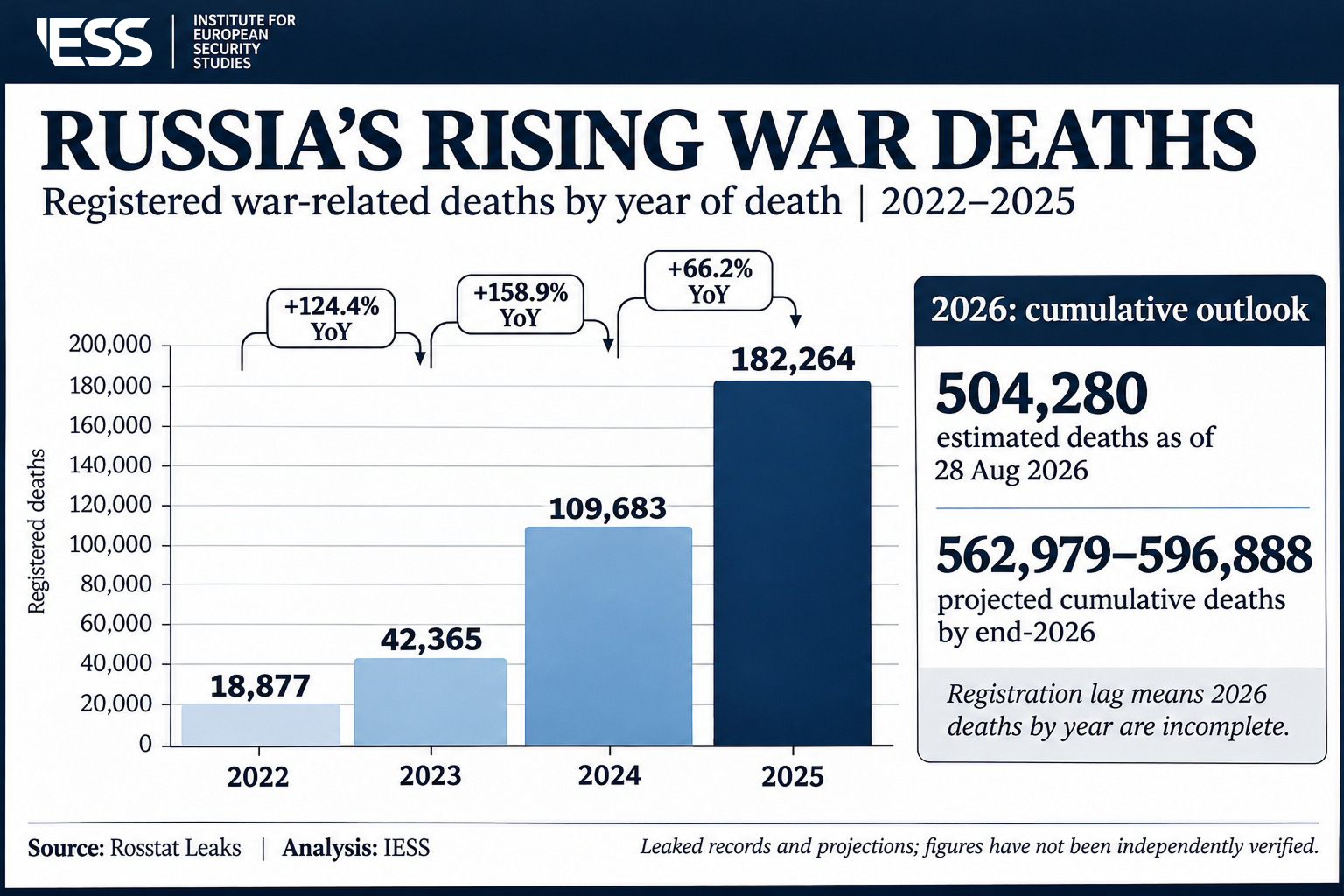
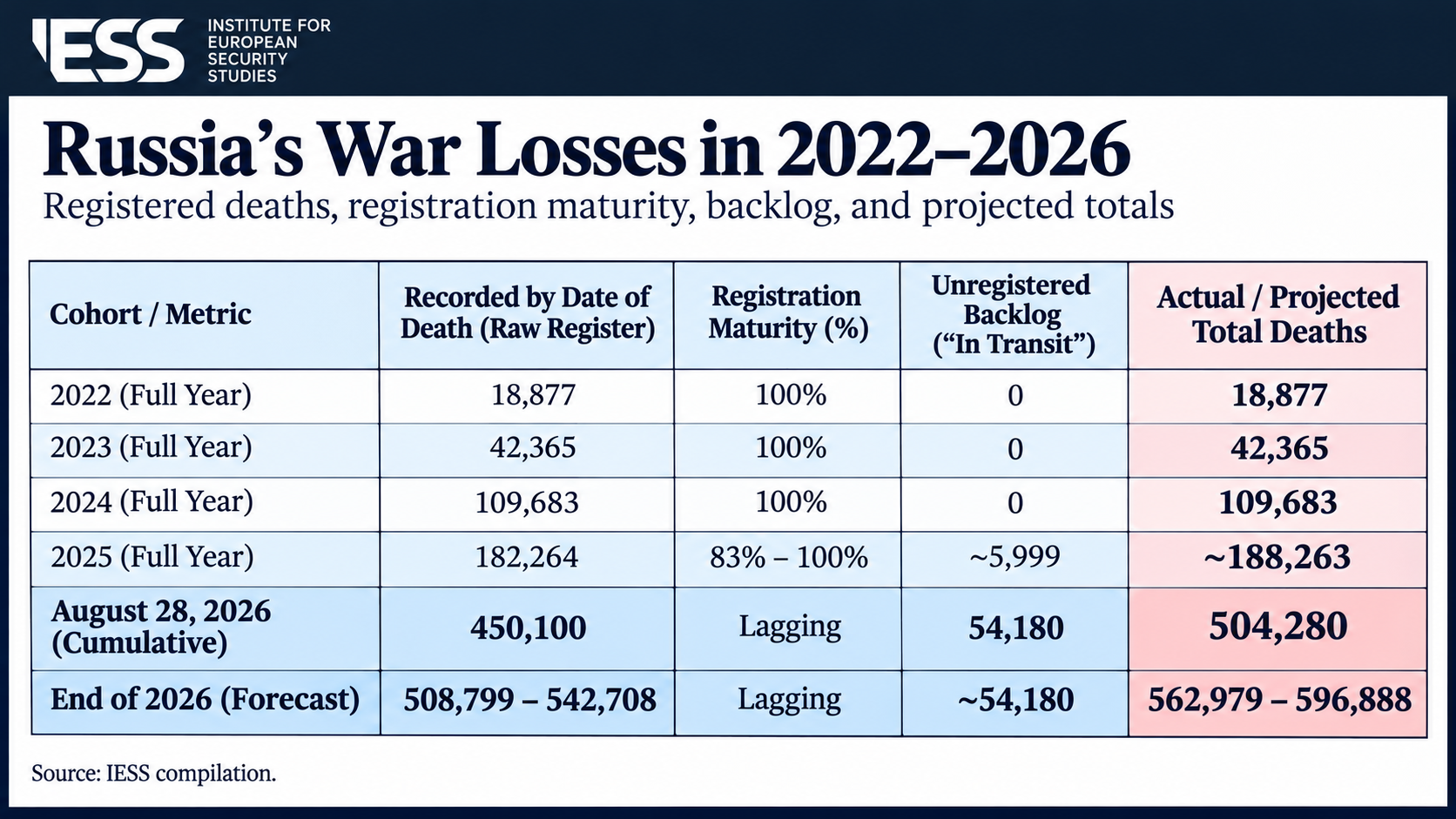
Over the last six complete months before the August 28 extract, Rosstat logged an average of 18,280 new military death certificates every single month—a 1.26x acceleration compared to the 14,527 monthly average during the same period in 2025. Accounting for the 54,180 corpses currently moving through military morgues and regional registries, Russia's true death toll crossed 504,280 by late August 2026, with cumulative projections reaching between 562,979 and 596,888 by the end of the year.
At the current six-month intake pace, Rosstat will register between 206,322 and 225,216 military deaths in calendar year 2026 alone, pushing the actual number of dead Russian soldiers to between 563,000 and 597,000 by December 31, 2026. As we demonstrated in our recent analysis, No Decree Needed, Russia has avoided a second public mobilization decree by relying on street abductions, debt-forgiveness traps, and criminal recruitment networks that bring in roughly 30,000 men a month.
The Rosstat leak proves why that recruitment machine is failing to expand the army: over 18,000 men are coming back in coffins every month, meaning permanent fatalities alone consume nearly two-thirds of Russia's entire monthly intake before a single severely wounded soldier is even counted.
The fourth horseman of Russian mortality
Since 2024, the Russian government has classified detailed cause-of-death statistics in its public demographic yearbooks. The leaked master database reveals why: a "Special Military Operation" that the Kremlin insists does not affect ordinary Russian life has become the fourth leading cause of death in the Russian Federation.
Across the entire population of Russia between 2022 and August 2026, only three medical conditions killed more citizens than the invasion of Ukraine:
- Chronic ischemic heart disease (Code I25): 2,217,461 deaths
- COVID-19 (Code U07): 668,292 deaths
- Cerebrovascular diseases (Code I67): 665,012 deaths
- War against Ukraine (All military deaths): 450,100 deaths
- Cerebral infarction/stroke (Code I63): 436,771 deaths
- Cardiomyopathy (Code I42): 366,422 deaths
- Bronchial and lung cancer (Code C34): 27618 deaths
Even more devastating for Russia's long-term economic survival is the age distribution of the dead. While heart disease and strokes primarily claim pensioners, the war is precision-Guided demographic excision aimed at Russia's prime industrial and reproductive workforce. Men account for 99.4% of the war dead (with women comprising 0.6%, including military medics and border-town casualties).
More than half of all Russians killed in the war (exactly 246,871 men) belonged to the prime working-age bracket of 30 to 49 years old.
The single largest five-year mortality cohort is men aged 35 to 39 (69,306 killed), followed immediately by ages 40 to 44 (66,435 killed), 45 to 49 (56,467 killed), and 30 to 34 (54,663 killed). At the younger end of the spectrum, the database records 6,064 dead teenagers aged 15 to 19 and 33,684 men aged 20 to 24, debunking Putin's repeated assurances that young conscripts and yesterday's schoolchildren are kept away from combat zones.
At the opposite end, the desperation of Russia's debt-driven contract system is visible in the deaths of 8,354 men aged 60 to 64 and 2,401 men over the age of 65.
Hollowing out the industrial heartland
For the first two years of the invasion, Western commentary frequently assumed that Moscow was insulating its core economic regions by drawing cannon fodder exclusively from ethnic minority republics in the North Caucasus and depressed villages in Buryatia or Tuva. However, the Rosstat residential address data reveals a far more targeted geographic extraction centered on Russia's industrial hubs and primary military staging grounds.
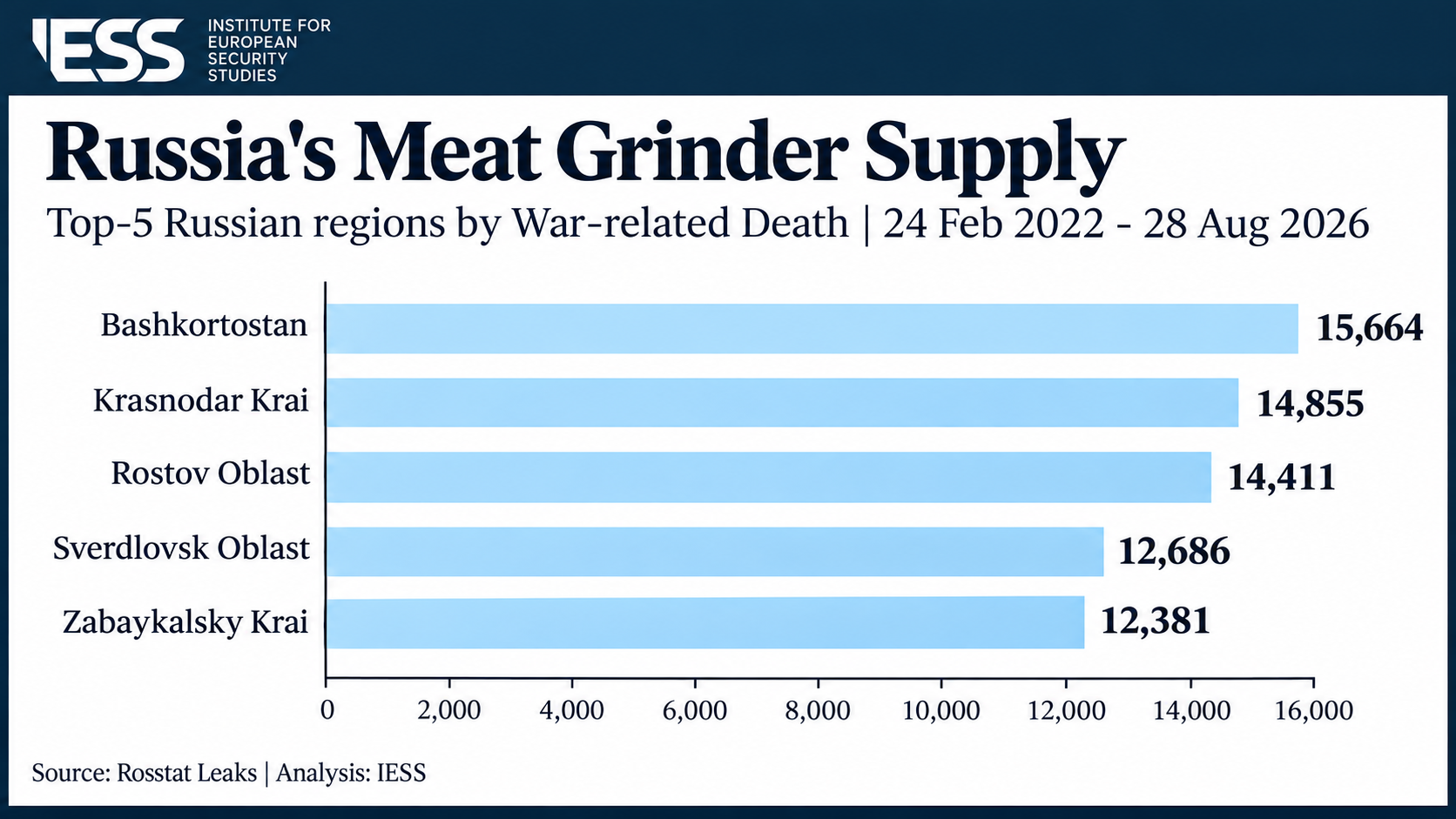
While registrars have hidden the exact street address in 52% of all records (229,283 certificates), the regional territory codes remain intact, highlighting five specific regions bearing the heaviest casualty burden.
1. Republic of Bashkortostan (15,664 dead). Leading all Russian regions in total war fatalities, Bashkortostan represents a deadly combination of intensive contract recruitment in a heavily populated industrial-agricultural region within the Volga Federal District and substantial volunteer battalion mobilization.
2. Krasnodar Krai (14,855 dead). As the top casualty region in the Southern Federal District, Krasnodar serves as a major recruiting ground for both regular military formations and private mercenary forces, driven by its large rural population and high concentration of military veterans.
3. Rostov Oblast (14,411 dead). Functioning as the primary logistical command hub for the Southern Military District, Rostov's high losses reflect both frontline mobilization and its proximity to active combat zones, exposing border-region garrisons to direct attrition.
4. Sverdlovsk Oblast (12,686 dead). Located in the Ural Federal District, Sverdlovsk illustrates the severe demographic toll on Russia's heavy manufacturing and defense-industrial core, where aggressive recruiting campaigns draw directly from factory workforces.
5. Zabaykalsky Krai (12,381 dead). Representing the Far Eastern Federal District, Zabaykalsky demonstrates the continued disproportionate strain on economically depressed eastern regions, where military service remains one of the few available avenues for social mobility and financial survival.
Across the broader federal structure, the Volga Federal District remains the overall largest donor of manpower, accounting for 21.7% of all war deaths (nearly 98,000 dead), followed by the Central Federal District at 16.9% (over 76,000 dead), the Southern Federal District at 15.3%, the Siberian Federal District at 14.7%, and the Far Eastern Federal District at 12.0%. In contrast, the North Caucasian Federal District accounts for just 4.3%.
This geographical concentration exposes a critical vulnerability in Moscow's war effort: by drawing heavily from key industrial and agricultural regions like Bashkortostan, Sverdlovsk, and Krasnodar, the Kremlin is systematically depleting the skilled labor force required to sustain its defense manufacturing and domestic economy.
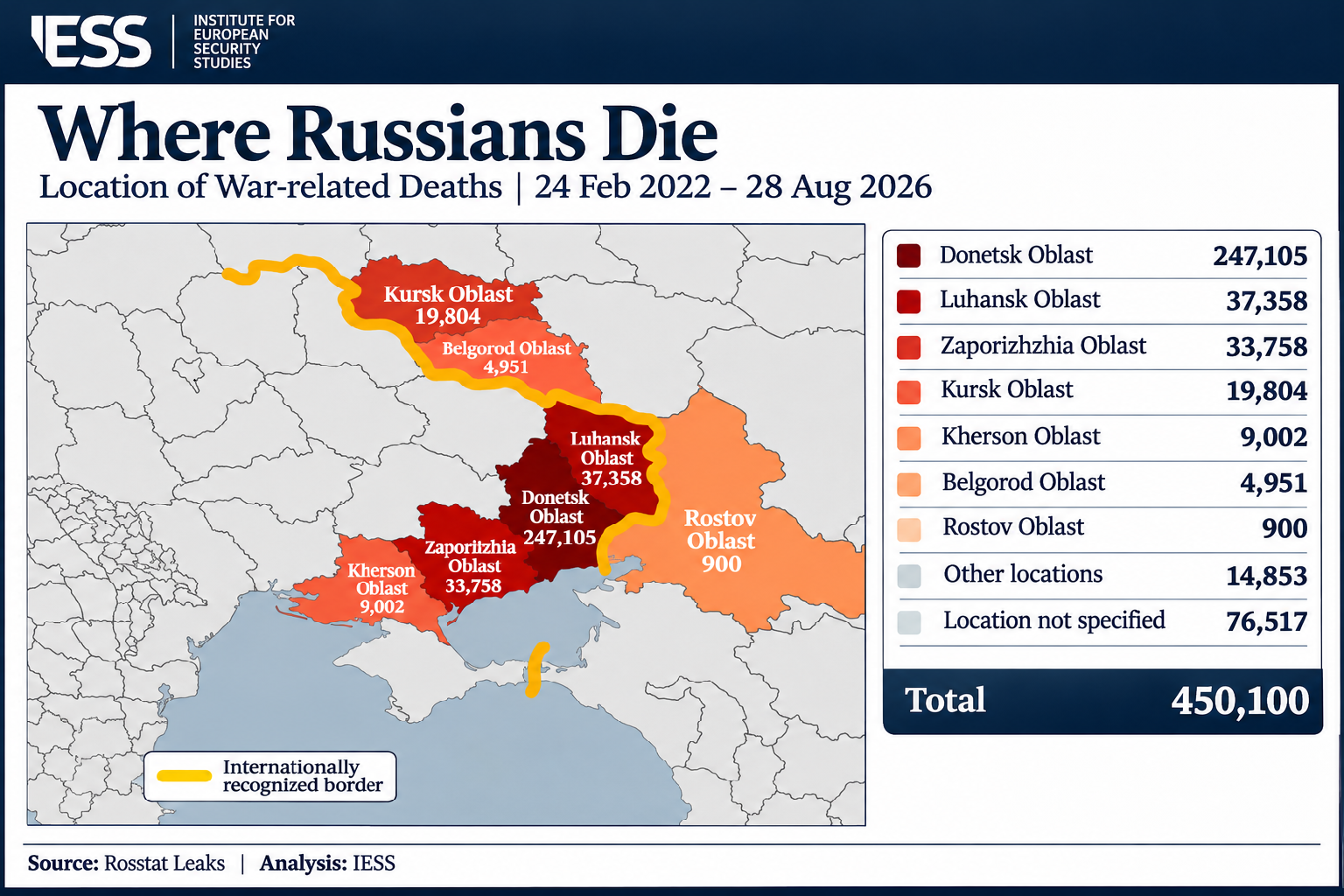
As for where these men die, the Rosstat database confirms that Donetsk Oblast remains the primary slaughterhouse of the Russian army. Exactly 54.9% of all death certificates list the occupied "Donetsk People's Republic" as the place of death, compared to 8.3% in Luhansk Oblast, 7.5% in Zaporizhzhia Oblast, and 2.0% in Kherson Oblast. Notably, the war's boomerang effect onto Russian territory is permanently etched into the state registry: 4.4% of all Russian military deaths (nearly 20,000 soldiers) were officially recorded inside Kursk Oblast, alongside 1.1% (nearly 5,000 dead) in Belgorod Oblast. Another 17.0% of certificates have the place of death scrubbed completely.
What Europe must learn from the Kremlin's ledger
For policymakers in Washington, Brussels, and Central European capitals, the Rosstat leak dismantles two persistent myths that have paralyzed Western strategic thinking throughout 2026.
First, it destroys the narrative peddled by pro-Kremlin voices in Bratislava, Budapest, and Prague that Russia possesses an inexhaustible human reservoir and is marching toward an inevitable victory of attrition. An army that loses 18,877 dead in 2022, 42,365 in 2023, 109,683 in 2024, 182,264 in 2025, and is on track to lose over 215,000 dead in 2026 is not demonstrating strategic invincibility. It is experiencing exponentially degrading battlefield efficiency, paying more than six dead soldiers for every square kilometer of Ukrainian scorched earth because its mechanized armor stocks are depleted and its infantry tactics have been reduced to disposable human waves.
Second, the breach itself exposes the hollowness of Russia's technological sovereignty. Just weeks after Ukrainian strikes physically liquidated Yandex's supercomputers, the Rosstat catastrophe proved that Russia's software "import substitution"? which forced federal ministries to migrate from Western VMware infrastructure to domestic virtualization platforms after 2022. Thus, it has left the Kremlin's most sensitive state secrets defenseless against sophisticated cyber operations.
The Kremlin hides its dead behind blank certificate lines and twelve-month registration delays for a single reason: it knows that the mathematical reality of half a million corpses destroys the illusion of Russian strength.
Every time Western politicians argue that supporting Ukraine is a financial "black hole" or pressure Kyiv into unilateral concessions, they ignore the numbers sitting inside Moscow's own servers. Ukrainian defense forces, backed by a fraction of one percent of Western GDP, have systematically dismantled the demographic and military core of the Russian Empire.
The objective for Europe is not to rescue Vladimir Putin from his own graveyard arithmetic through premature truces, but to provide Ukraine with the long-range weapons and technological superiority required to make the cost of every additional hectare unsustainable for the regime in Moscow.