
IESS Statement
On disinformation shared by Slovak Police regarding death of Ukrainian civilian
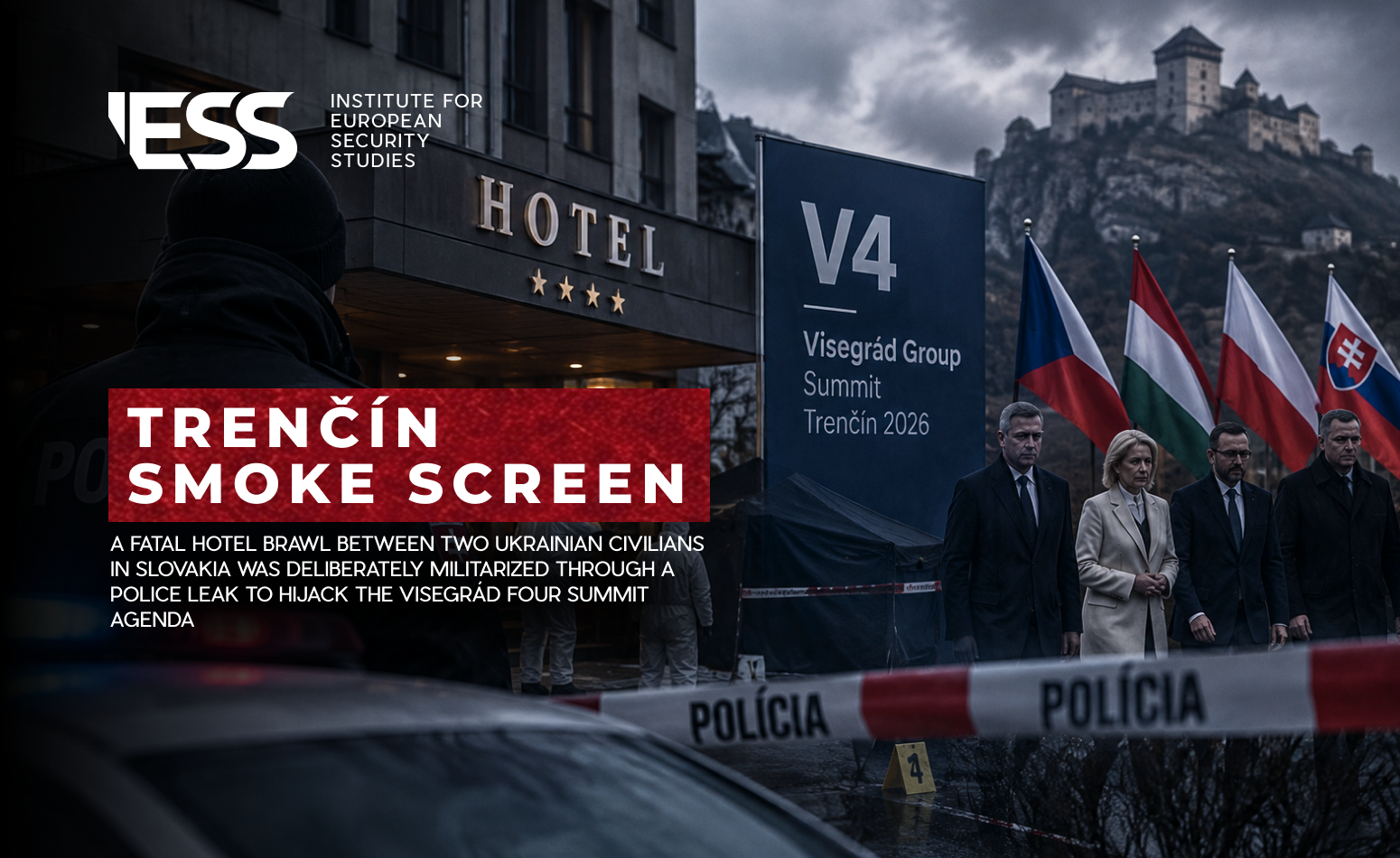
On November 5, 2026, the western Slovak city of Trenčín became the temporary diplomatic capital of Central Europe. The presidents of the Visegrád Four states, Czechia, Hungary, Poland, and Slovakia, gathered in the city alongside European Commission President Ursula von der Leyen for a high-level summit focused on regional security and European policy.
Yet just as the summit reached its culmination on Thursday morning, the Slovak and Czech media landscape was overtaken by a sensationalist crime story that pushed the presidential discussions out of the headlines.
Initial reports published by Polícia SR and recited by the Slovak weekly Plus 7 dní (now material is restricted), and rapidly amplified by Nový Čas, Aktuality.sk, HNonline.sk, and the Czech daily Blesk, claimed that two members of the Ukrainian Air Force undergoing military training in Slovakia had fought with knives in a local hotel, leaving one soldier dead.
By the time official denials from Kyiv dismantled the story that evening, the fabricated military angle had already served its tactical purpose: overshadowing a high-profile European diplomatic gathering with a crude psychological operation.
Every element of the military narrative proved to be false. No Ukrainian pilots or aviation personnel were involved in the incident, and none are currently training in Slovakia.
What actually occurred in Trenčín was a domestic criminal offense between civilian businessmen that was intentionally twisted inside the local law enforcement apparatus and fed to the press at a politically convenient hour.
Anatomy of a midnight crime and a morning fabrication
To understand how an ordinary criminal investigation was weaponized into an international incident, it is necessary to separate the police blotter from the media spin. Shortly after midnight on the night of November 4 to November 5, patrols from the Trenčín Regional Police Directorate were dispatched to a local lodging facility following reports of a violent altercation.
According to investigators and emergency responders, an argument between two 53-year-old Ukrainian men escalated into a physical fight during which one man stabbed the other multiple times in the chest and abdomen. Petra Klimešová, spokesperson for the Slovak Emergency Medical Service Operational Center, confirmed that paramedics resuscitated the victim at the scene and transported him to the Trenčín hospital on artificial lung ventilation, where he later died from his wounds. Police officers detained the other 53-year-old man at the hotel, opened a criminal investigation into premeditated murder, and launched a search for a third individual who had been present at the scene.
In her official press statements, Trenčín regional police spokesperson Petra Klenková maintained standard procedural caution, declining to release the identities, nationalities, or occupations of the victim and the suspect while forensic actions were underway.
However, the media wave did not start in a vacuum: the initial claim that the two men were Ukrainian soldiers originated directly from a leak inside the Trenčín police force.
Hours after the midnight arrest, exactly as the Visegrád Four delegations were convening in the city, police sources fed journalists the false detail that the crime involved active-duty Ukrainian military personnel. What should have remained a routine municipal murder investigation was instantly elevated into a geopolitical scandal.
Exploiting industrial geography for plausibility
The rapid spread of the Trenčín rumor illustrates how regional information operations graft a calculated fabrication onto verifiable local facts. Two 53-year-old Ukrainian citizens had indeed fought in a Trenčín hotel, and one of them had died. To make the leap from civilian travelers to active-duty soldiers believable for editors and readers, the architects of the leak relied on Trenčín's well-known industrial geography.
Trenčín is a historic hub for Slovakia's defense and aerospace sector, hosting major aviation maintenance and repair facilities, including the state-owned Letecké opravovne Trenčín (LOTN). When Plus 7 dní broke the story, journalists immediately pointed to the presence of these aviation enterprises as circumstantial proof that Ukrainian Air Force specialists were quietly stationed in the city for technical training.
Once that false premise entered the bloodstream of Central European media, the narrative snowballed: in neighboring Czechia, Blesk ran headlines explicitly linking the alleged fatal stabbing between Ukrainian soldiers to the presence of Czech President Petr Pavel and European Commission President Ursula von der Leyen at the Trenčín summit.
The operational logic behind the leak was straightforward: force the public and the press corps to talk about alleged violence among Ukrainian troops on NATO soil rather than the substantive political outcomes of the Visegrád summit.
Rapid verification and the collapse of the military myth
The attempt to sustain the military narrative collapsed as soon as independent analysts and Ukrainian defense institutions intervened. Immediately after the first reports appeared in Slovak media, IESS initiated direct verification with the General Staff of the Armed Forces of Ukraine and the Ukrainian Air Force Command before any formal government communiqués were released.
Both military commands confirmed to IESS that no Ukrainian servicemen had participated in any incident in Trenčín, allowing the Institute to begin debunking the fabrication publicly and identify it early on as a targeted disinformation maneuver aimed at disrupting the Visegrád Four meeting.
Official institutional denials followed shortly afterward. Speaking to Ukrainian and international journalists, Colonel Yuriy Ihnat, head of the Communications Department of the Ukrainian Air Force Command, categorically rejected the claims circulating in the Slovak press.
"Neither pilots nor other aviation personnel are currently undergoing training in Slovakia. Many Ukrainian soldiers undergo aviation training abroad, but not in Slovakia," Ihnat stated.
Later that evening, the Ministry of Foreign Affairs of Ukraine issued an official clarification that dismantled the remaining speculation. The ministry confirmed that all individuals involved in the Trenčín hotel incident were civilians, noting that two of the men were in Slovakia on a commercial business trip and had no affiliation whatsoever with the Defense Forces of Ukraine.
Law enforcement as an instrument of hybrid distraction
While the factual record was corrected within twenty-four hours, the mechanics of the Trenčín incident expose a troubling vulnerability inside Slovakia's security institutions. Since the return of Robert Fico's cabinet in Bratislava, official rhetoric that normalizes Kremlin talking points and questions European military aid to Kyiv has reshaped the operating culture of Slovak state agencies.
When senior government officials routinely portray Ukraine as a source of instability, that political posture filters down into the ranks of the police and intelligence services. Fabricating a link between a violent crime and the Ukrainian Armed Forces feeds directly into established disinformation tropes across Central and Eastern Europe.
Such narratives are designed to achieve two objectives simultaneously: erode public sympathy for Ukrainian citizens residing or working in European Union member states, and portray bilateral defense cooperation with Kyiv as a direct hazard to local public safety.
Even more concerning is the timing. Staging or amplifying an anti-Ukrainian media provocation in the exact host city of a presidential summit attended by the head of the European Commission demonstrates a willingness by elements within the Slovak security apparatus to embarrass visiting allies and sabotage the diplomatic agenda on their own territory.
Accountability for institutional disinformation
The Trenčín fabrication stands out not for its sophistication, which was remarkably low, but for the fact that it was set in motion through an official law enforcement channel.
The anatomy of the Trenčín information operation relied on four distinct steps:
- a real criminal altercation between two 53-year-old Ukrainian civilians was logged by local police just hours before the peak of the Visegrád Four summit,
- an official inside the Trenčín police structure leaked distorted information to the press, falsely identifying the civilian businessmen as Ukrainian Air Force personnel,
- Slovak tabloids used the city's aviation repair industry as a convenient backdrop to make the training story appear credible without official confirmation,
- regional media outlets across Slovakia and Czechia amplified the sensationalized narrative, diverting public attention away from the political summit in Trenčín.
This sequence did not happen by accident; it required a deliberate abuse of official access inside the police force.
Allowing law enforcement personnel to act as anonymous spin doctors for anti-Ukrainian psychological operations erodes public trust in the Slovak police and damages the credibility of a NATO member state during high-level international events: simply correcting the record through Ukrainian diplomatic statements is insufficient when the source of the falsehood sits inside a European police department.
IESS calls for an immediate internal investigation within the Trenčín Regional Police Directorate to identify the specific official or communications officer who leaked the fabricated story about Ukrainian soldiers to the media. A law enforcement officer who uses a murder investigation to manufacture political disinformation during an international summit has no place in public service and must be dismissed immediately.