
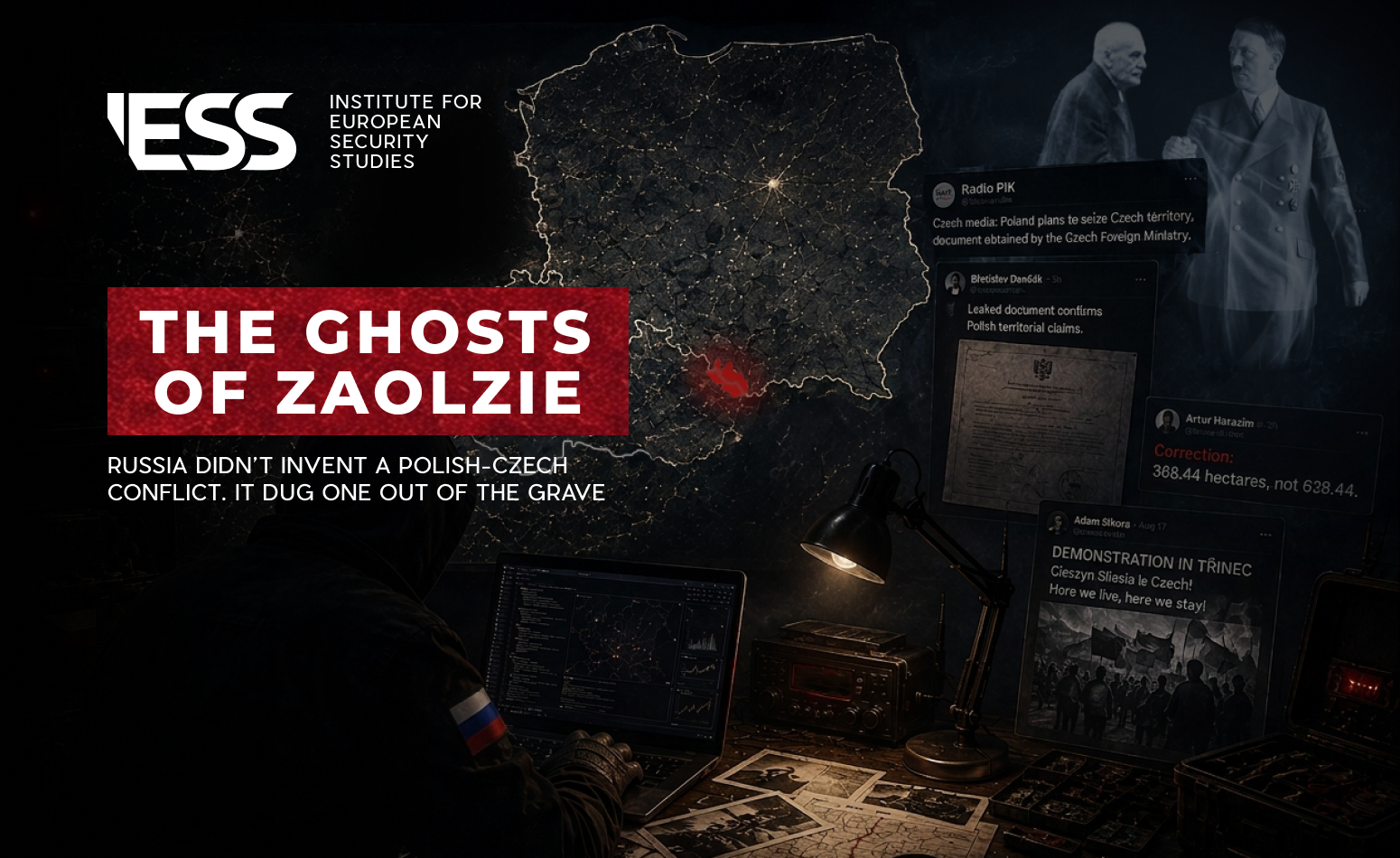
The Ghosts of Zaolzie
A hacked Polish radio station and a chain of AI-generated fakes tried to convince two allies their border was suddenly in dispute.
At around 17:00 on August 16, hackers broke into the website of Radio PiK, a regional station in Bydgoszcz, using a password stolen from one of its employees. They used the access to publish a single fabricated article: "Czech media: Poland plans to seize Czech territory, document obtained by the Czech Foreign Ministry." Editor-in-chief Cezary Wojtczak reported the breach to Poland's press agency, the station deleted the article, and the country's Central Bureau for Combating Cybercrime opened an investigation.
On its own, that would read as a contained incident, an embarrassing but minor intrusion quickly cleaned up. Poland's state research institute, NASK, says it wasn't isolated. Fake posts about the Polish-Czech border had already been circulating on social media before anyone touched Radio PiK's servers, which means the hack wasn't the start of the operation. It was one beat in a sequence.
A trail of fakes
Before the radio hack, an account impersonating Czech Ambassador to Poland Břetislav Dančák began posting what it claimed was a leaked Polish foreign ministry document, one supposedly showing Warsaw demanding a piece of Czech territory. The document was fabricated, almost certainly with AI assistance; one of the clearer tells is its closing line, which mixes Czech and Polish in a way no genuine ministry document would. The same fake-ambassador account went further, sharing an AI-generated video of a man presented as Dančák denouncing the very Polish claims the operation had just invented.
A second wave of fake accounts, this time impersonating Artur Harazim, a Polish deputy foreign ministry state secretary, added a "correction": the disputed territory, they said, was actually 368.44 hectares, not the 638.44 hectares an earlier post in the campaign had claimed. This is a recognizable technique, sometimes called reverse fact-checking, in which a disinformation operation stages its own correction to make the underlying claim look like it survived scrutiny rather than originated from nowhere.
The demonstration that never existed
The campaign's most elaborate fabrication was a protest that was never going to happen. An online profile calling itself "Adam Sikora" promoted a Saturday demonstration in the Czech town of Třinec under the slogans "Cieszyn Silesia is Czech" and "Here we live, here we stay," built around the claim that Poland wanted to annex part of the area. Town officials said no one had actually applied to hold the gathering, well past the legal deadline to do so. The promotional video used the logo of the KOVO trade union without permission; the union publicly distanced itself once it found out.
"Adam Sikora" does not appear to be a real person. The profile picture shows signs of AI generation, and to build credibility the account had reportedly listed a house for sale near Czech Těšín, complete with AI-generated property photos that Facebook itself flagged as synthetic. A demonstration built to look grassroots turned out to have no organizer, no permit, and, most likely, no photographs of anything that actually exists.
Changing numbers
The inconsistency running through all of this is its own tell. Harazim's fake "correction" put the disputed area at 368.44 hectares. Radio PiK's forged article, separately, described Poland eyeing roughly 600 hectares of Czech land. Real diplomatic disputes tend to converge on one figure. Fabricated ones, assembled by different accounts without a shared script, tend to drift.
The number that actually matters, 368 hectares, is real, but it describes something else entirely: a rounding difference from the 1958 demarcation of the Polish-Czechoslovak border, agreed under pressure from Stalin to straighten and shorten the line by about 80 kilometers across 85 separate adjustments. Once the land each side gained and lost was tallied, Czechoslovakia ended up roughly 368 hectares ahead. It has sat there, resolved and functionally irrelevant, for nearly seventy years, which is exactly what made it useful: a number just real enough to survive a cursory search, attached to a claim that is entirely invented.
Old wound, new author
The campaign's deeper target isn't a few hundred hectares. It's Zaolzie, or Trans-Olza, the wider Cieszyn Silesia region Poland seized from a weakened Czechoslovakia in 1938, months after losing the same territory to Czechoslovak forces in a short, bitter border war in 1919. Poland restored the 1920 border in 1945, and the frontier stopped meaning much of anything in practice once both countries joined Schengen in December 2007; today roughly 30,000 Czech citizens in the area still identify as ethnic Poles.
Polish Foreign Minister Radosław Sikorski's response leaned directly on that history, urging Poles not to let anyone drive a wedge between the two countries and calling the 1938 seizure one of the most shameful episodes in Polish foreign policy, while noting that President Lech Kaczyński formally apologized for it in 2009, calling it not just a mistake but a sin Poland was capable of confessing to. Czech historian Eva Klusová, of the Academy of Sciences, put the mechanics more bluntly: the operation is effective precisely because it targets a division that already runs through the region rather than inventing one from scratch.
The familiar shape
None of this is Czechia's first brush with this kind of pressure this year. In June, IESS documented a pro-Russian hacker group's breach of Plzeňský Prazdroj, the brewer of Pilsner Urquell, explicitly tied to Czech military aid for Ukraine. Neither operation demanded money. Both used a civilian target to send a political message, and both were built to make ordinary people, not governments, feel the cost first.
The same logic runs through Poland's own experience this summer, from a stray Russian cruise missile that crossed the border undetected in late July to a fabricated document claiming the opposite direction of aggression entirely. One is kinetic and the other is purely informational, but both are probes, testing where a border, a radar network, or a century-old grievance can be made to look uncertain again. A manufactured land dispute between two NATO and EU members costs Moscow almost nothing to run and asks for very little to succeed: a headline shared before it's checked, an old resentment reopened, a few hours where two allies argue with each other instead of about the war on their actual eastern border.
The border between Poland and Czechia did not move in August. Nothing about it changed at all. The only part of the story that should worry anyone is that a fabricated claim could travel this far, this fast, on this little evidence.