
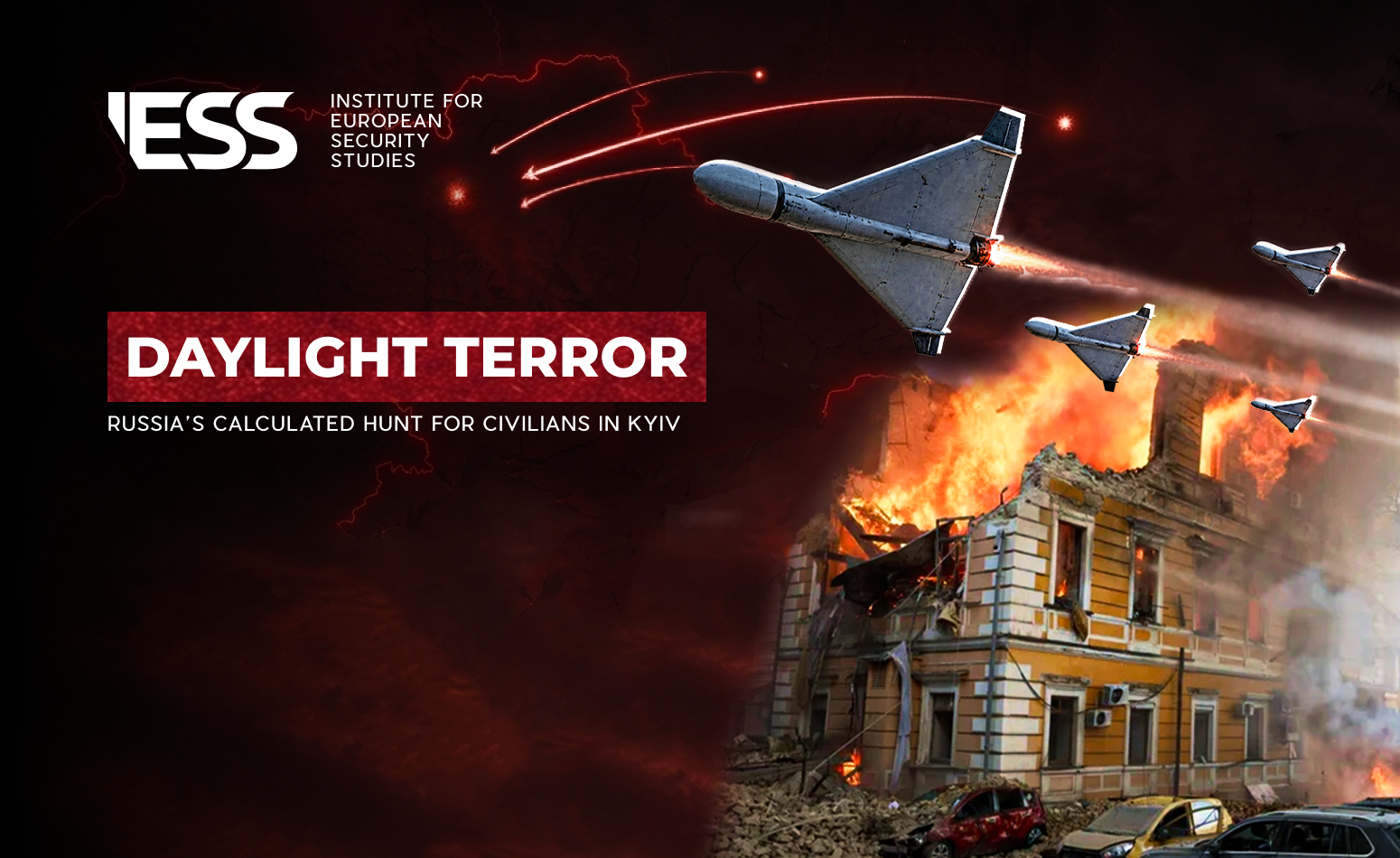
Daylight Terror
Russia’s calculated hunt for civilians in Kyiv
On September 28, a massive, coordinated drone swarm struck directly at the heart of Ukraine's civilian infrastructure, devastating several non-military sites in Kyiv, including the National Academy of Sciences of Ukraine (NANU) and the Dobrobut medical center.
By the time the skies temporarily cleared, two people were dead and 19 others were injured, including three teenagers.
This was not a military operation gone awry, nor was it a tragic miscalculation. It was a methodical, programmed assault on research halls and medical facilities in the heart of Europe. Targeting centers of science and healthcare proves unequivocally that the Russian Federation operates not as a conventional military power, but as a terrorist state. For the international community, expressing diplomatic concern is no longer just inadequate – it is an insult to the victims. The West must answer this escalation with unrestricted military backing for Ukraine, aimed at destroying this threat at its very origin.
The "collateral" lie
There is a dangerous, sanitizing narrative that frequently finds its way into international reports: the assumption that the destruction of residential areas in Kyiv is primarily the tragic byproduct of successful air defense interceptions, electronic warfare, or falling debris. September 28 forces us to discard that illusion completely.
These were direct, programmed, kinetic strikes. Russian operators did not miss their military targets; they hit exactly what their navigation systems were locked onto. They deliberately fed the GPS coordinates of medical clinics, local cafes, and academic halls into the guidance systems of high-speed, jet-powered UAVs.
When a drone slams directly into the fourth floor of a seven-story administrative building in the middle of a dense urban center, it is not an accident of gravity. It is a weapon utilized exactly as intended: to slaughter civilians and flatten the infrastructure of daily life.
Science and health in crosshairs
To understand the sheer cynicism of the September 28 assault, one only needs to map the geography of the impacts. In the central Shevchenkivskyi district, the National Academy of Sciences (NANU) took a direct hit.
The explosion sparked a severe fire and claimed two lives. Among the dead was the assistant to Volodymyr Horbulin, First Vice President of NANU, who also sustained injuries in the blast.
The Kremlin literally aimed its weapons at the minds driving Ukrainian science.
The terror systematically extended across almost every district, meticulously picking off locations meant for healing, commerce, and living. In the Holosiivskyi district, the "Dobrobut" medical center (a place of recovery) was struck, alongside a local cafe situated near a gas station. In the Podilskyi district, the shockwaves from direct impacts shattered the windows of residential apartment blocks, injuring three teenagers, two 15-year-olds and a 17-year-old, who required emergency medical intervention. In Obolon, gas station pumps were set ablaze.
This urban bombardment did not happen in a vacuum. It follows a lethal, calculated strike just a day prior on the "Stolychnyi" wholesale food market in Sofiivska Borshchahivka: the primary food artery for the capital’s residents.
Russia is not targeting the Ukrainian military; it is trying to execute the Ukrainian public.
Weaponizing the workday
What we are witnessing is a cold, calculated evolution in Russian terror tactics. Since late August, the Kremlin has steadily shifted away from its traditional nocturnal barrages, favoring daylight drone swarms instead.
There is a grim, pragmatic cruelty behind this shift. Nighttime strikes, while exhausting, allowed civilians to shelter in corridors, basements, or subway stations. The Russian military establishment realized this and adapted. Their solution is to strike at noon.
By launching swarms of UAVs during peak commuting and working hours, Russia maximizes the psychological shock and the physical vulnerability of the population. They want to catch people in traffic jams, in office chairs, and in grocery lines. The objective is to completely paralyze the capital's economy, erase the concept of a "safe hour," and force a traumatized, sleep-deprived, and bloodied population into demanding submission.
End the limits
Nobody can`t negotiate with a regime that programs drones to detonate in civilian hospitals in broad daylight, and nobody cannot defeat it by fighting with one hand tied behind your back.
Condemnations, sanctions packages, and strongly worded UN speeches do not intercept jet-powered drones. When a state leverages its entire military-industrial complex to wage a war of terror against unarmed civilians, Western diplomatic hedging crosses the line into complicity.
The only proportional and logical response to the daylight terror of September 28 is to permanently sever the restrictions placed on Ukraine’s military. Kyiv urgently requires a massive, immediate influx of advanced air defense systems. Ukraine needs to use Starlink terminals to strike deep into Russian territory and must be given such a right.
The West must stop demanding that Ukraine “can`t catch the arrows”: it is time to give Kyiv everything needed to burn the launch sites, the airfields, and the logistical hubs that make this daytime slaughter possible – anything less is a green light for Moscow to continue the hunt.