
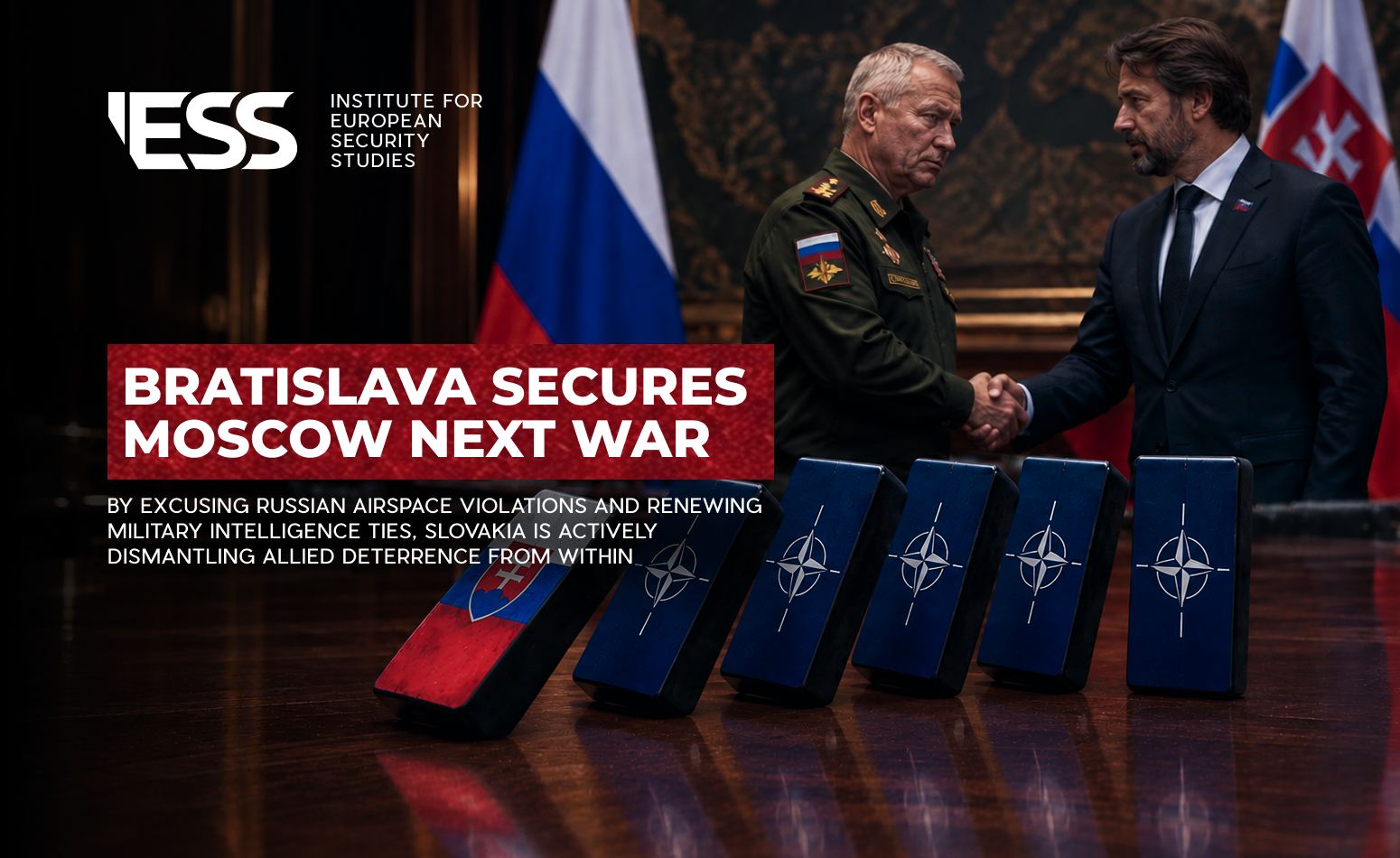
Bratislava secures Moscow next war
By excusing Russian airspace violations and renewing military intelligence ties, Slovakia is actively dismantling allied deterrence from within
On October 6, 2026, Slovak Defense Minister Robert Kaliňák delivered a statement that effectively nullifies his country’s defensive posture: Bratislava, he declared, does not perceive Putin's Russia as a threat.
Speaking to the press, the Deputy Prime Minister (and co-founder of Robert Fico’s ruling Smer-SD party, by the way) actively rebuked the German Foreign Minister's assessment of Moscow as Europe's primary danger. Instead, Kaliňák framed Slovakia's position as a noble pursuit of "good relations" and "de-escalation."
What is most cynical about this statement is that it was delivered against the kinetic reality of Russian jet-powered drones continuing their systematic, daytime slaughter of Ukrainian civilians just across NATO eastern border.
The juxtaposition is deliberate: Fico's government is signaling to Moscow that no matter the civilian body count in Kyiv, Russia will retain a steadfast political shield in Bratislava.
A blank check for hybrid warfare
Kaliňák’s doctrine of appeasement extends far beyond rhetoric, because it actively undermines NATO's collective security.
During his remarks, the Defense Minister explicitly urged the Alliance to ignore incidents of Russian drones and missiles violating NATO airspace.
He drew a convenient, artificial line between a "provocation" and an "armed attack," arguing that Article 5 should never be triggered by airspace incursions, suggesting Article 4 consultations are sufficient for states that "simply feel threatened."
Hovewer, by publicly demanding that NATO lower its threshold of response, the Slovak Defense Minister is handing the Kremlin a blank check.
It just tells Moscow: you can test our airspace, you can drop drones on allied soil, and we will politically protect you from a unified military response.
As we warned in our previous analysis, Russia's next war, failing to respond to these hybrid probes doesn`t prevent escalation, but invites it: by treating physical airspace violations as mere provocations to be ignored, Bratislava is rapidly eroding the deterrence that keeps the Alliance safe.
Inviting the spies back
While Kaliňák preaches de-escalation, his government is quietly executing institutional sabotage.
Bratislava has now officially fulfilled a promise Robert Fico made directly to Vladimir Putin during their May 2026 meeting in the Kremlin: the resumption of military cooperation at the attaché level.
Two Slovak soldiers have already been dispatched to the Russian capital, and a highly experienced Russian military officer is en route to Bratislava.
To understand the gravity of this decision, one only needs to look at recent history. The last time a Russian military attaché operated in Slovakia – four years ago, before being expelled by Eduard Heger’s government – he was caught on video handing cash to an associate of the Slovak disinformation outlet Hlavné správy to buy state secrets.
Therefore, inviting Russian military intelligence back into the capital of a NATO and EU member state is not "diplomacy."
It is the voluntary compromising of the Alliance's security architecture from within, granting Russian operatives a sanctioned foothold in Central Europe.
The cost of complicity
This intelligence appeasement happens simultaneously with a grim economic reality.
While the Smer-SD government renews ties with Moscow, the Russian military-industrial complex continues to rely on smuggled Western components to build the highly advanced weapons striking the Ukrainian rear. In Brussels, Slovakia frequently utilizes its veto power to block, delay, or dilute sanctions targeting these exact supply chains.
So, Bratislava is simply protecting the flow of components for the very weapons that are killing Ukrainian civilians in broad daylight.
The overarching strategy of the Slovak government is now impossible to ignore: as outlined in our recent analysis of Fico's historical revisionism, The Pedestal of Influence, the ruling coalition is systematically pulling the country back into the Russian sphere of influence.
Russians ultimate goal isn`t regional peace: the objective is to ensure that a designated state sponsor of terrorism retains a highly effective, disruptive proxy sitting at the highest decision-making tables of NATO and the European Union.
In the end, by lowering NATO's guard and reopening the doors to Russian intelligence, Slovakia is doing exactly what Moscow needs: disabling the West's defenses from the inside out.