
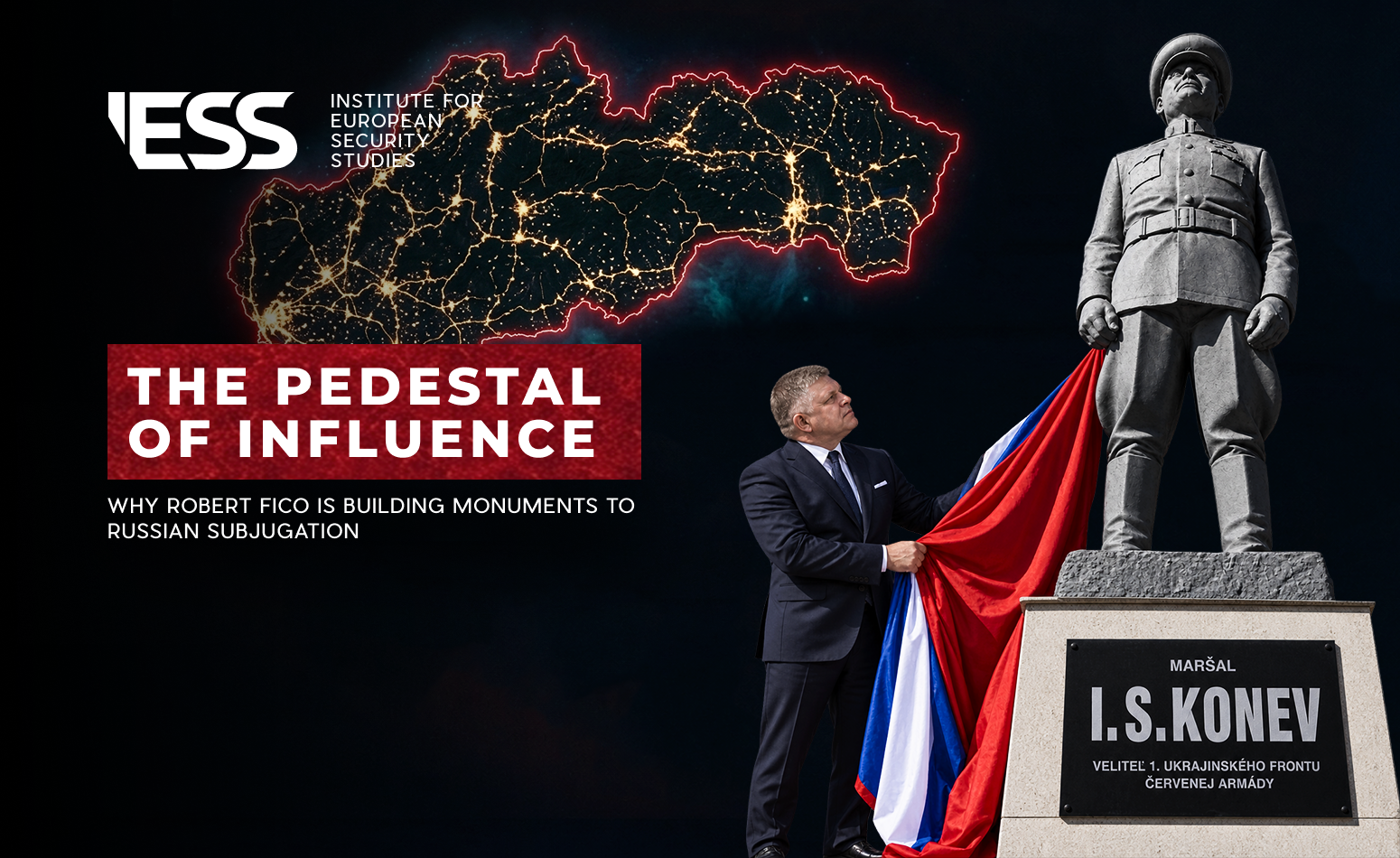
The Pedestal of Influence
Why Robert Fico is building monuments to Russian subjugation
In Slovakia, a new monument was recently unveiled to Soviet Marshal Ivan Konev: not only is this fact absurd for a 21st century country in the EU, but the most revealing detail of the ceremony was not even the bronze itself.
It was the diplomatic choreography surrounding it.
Russian Ambassador Sergey Andreev used his speech to specifically thank Prime Minister Robert Fico for personally initiating the project two years ago.
And don`t be mistaken, there wasn`t any passive diplomatic courtesy as it could be, because it was a public acknowledgment that a sitting head of government in a NATO and EU member state voluntarily went out of his way to erect a physical marker of Russian dominance on his own soil.
To understand the geopolitical severity of this gesture, one must look at who Ivan Konev actually was to Central Europe.
The Kremlin aggressively markets him as a World War II liberator, but his post-war resume is a masterclass in imperial subjugation: Konev, for example, commanded the Soviet troops that drowned the 1956 Hungarian Uprising in blood. Also, he oversaw the Soviet forces in East Germany during the construction of the Berlin Wall in 1961.
Furthermore, seven years later, he arrived in Czechoslovakia to lead the military reconnaissance delegation that laid the tactical groundwork for the Warsaw Pact invasion in late 1968.
It`s obvious for modern historians that Konev as a part of Moscow`s war machine had never represented the liberation from Nazism – he represents the seamless transition into the occupation by the USSR and will always remain as the historical personification of the Soviet boot.
This reality is exactly why, in 2020, neighboring Prague dismantled its own monument to Konev after years of fierce public debate and intense diplomatic threats from Moscow.
Therefore, Czech Republic recognized that honoring the architect of the 1968 invasion was fundamentally incompatible with modern state sovereignty.
Six years later, the Slovak Prime Minister voluntarily picked up the imperial marker that Prague discarded and placed it on a new pedestal in his own country.
By refusing to sever these historical chains, Fico is doing much more than pandering to domestic nostalgia: he is actively locking Slovakia inside Russia's cognitive sphere of influence.
This is more than a calculated feature of present-day hybrid warfare, because by validating Kremlin-approved historical myths, Fico leaves Slovak society highly susceptible to modern Russian narratives – a disinformation ecosystem that operates almost entirely on anti-Ukrainian, anti-NATO, and anti-EU messaging.
As IESS recently noted regarding Bratislava's muted response to Russian-linked sabotage at the Skyeton defense plant, Fico's government has made a strategic habit of looking the other way when Moscow tests its borders. However, erecting a monument to a Soviet enforcer goes a step further than turning a blind eye.
It is an active signal of ideological compliance.
Fico is doing everything in his power to ensure that Slovakia remains a "sweet land" for Russian operations – a fertile, welcoming ground where Moscow’s intelligence networks and propagandists can operate with minimal friction.
So what is really going on with “casual installment” of Konev`s monument? Slovak government that refuses to acknowledge the reality of its own past occupation choosing instead to celebrate the military commanders who enforced it.
Therefore, the actual Slovak government cannot be trusted to defend its allies against a modern aggressor – Russia.
Simply by elevating a symbol of Moscow's historical subjugation of Central Europe, Robert Fico is telling the Kremlin exactly what it wants to hear: that no matter what uniform the alliance wears, Bratislava's doors remain wide open to the East.