
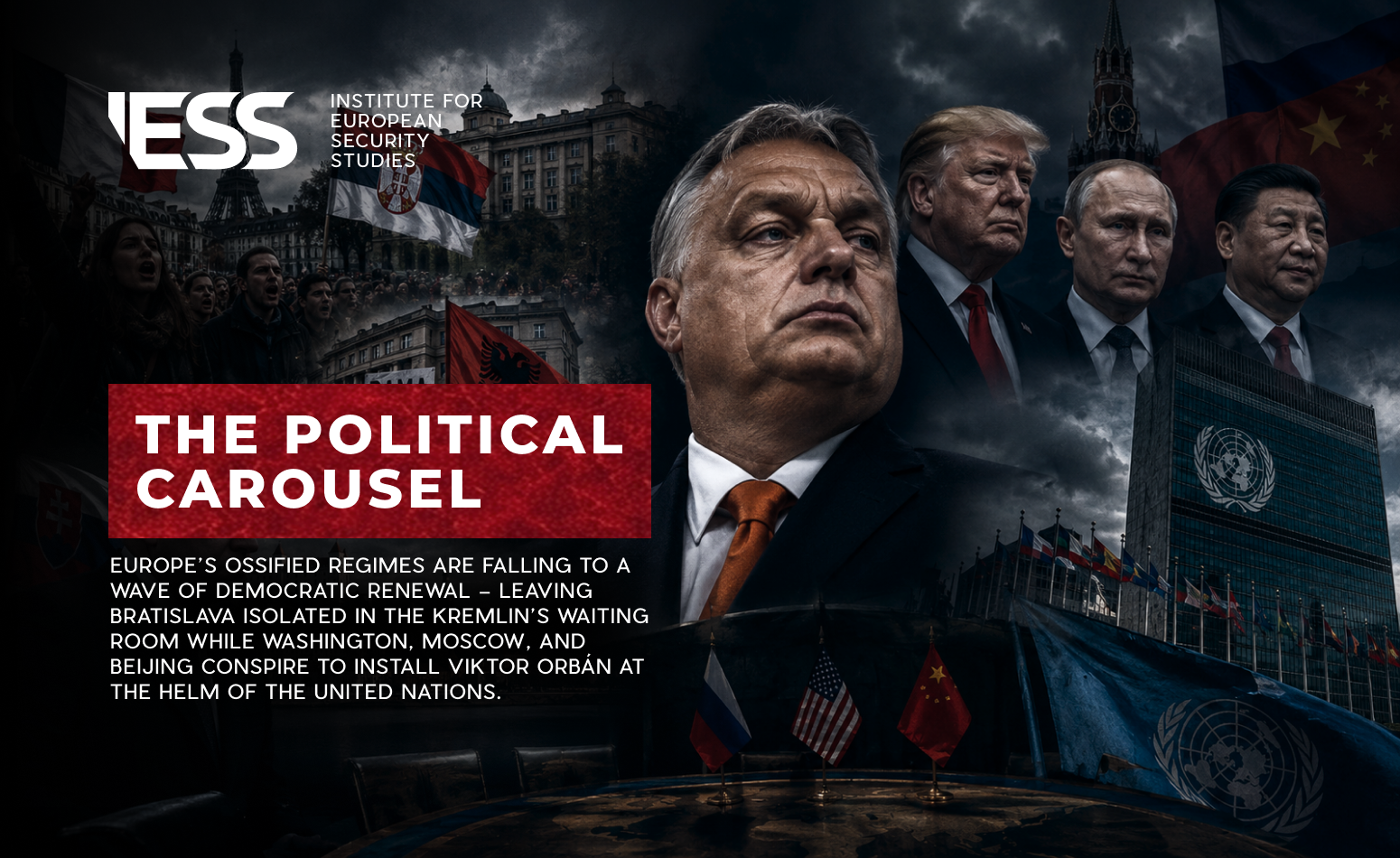
The Political Carousel
Europe’s ossified regimes are falling to a wave of democratic renewal – leaving Bratislava isolated in the Kremlin’s waiting room while Washington, Moscow, and Beijing conspire to install Viktor Orbán at the helm of the United Nations
The tremor starts in the West
Political shockwaves in Europe rarely respect national borders. The latest seismic shift began in France, where student protests and the decisive rise of Raphael Glucksmann in the center-left primaries signaled a broader European appetite for renewal and a rejection of political stagnation. While the initial detonation occurred in Paris, the structural aftershocks have traveled rapidly eastward, destabilizing some of the continent’s most entrenched political monopolies.
Across Central Europe and the Balkans, a clear pattern is emerging: voters and civil society are dismantling ossified, corrupt, and multi-vector regimes in favor of genuine democratic accountability and Euro-centrism. Yet as this political carousel spins, two glaring anomalies stand out, because a Slovak government desperately clinging to Moscow, and a deposed Hungarian autocrat being fitted for a global diplomatic parachute by Washington, Beijing, and the Kremlin.
Belgrade and Tirana: the end of “Strongman Era”
For over a decade, the Western Balkans served as a textbook laboratory for "stabilitocracy" – a model where local autocrats maintained domestic control through media capture and patronage while playing Brussels and Moscow against one another.
This week, that model collapsed in Serbia and entered a terminal crisis in Albania.
On October 25, Serbian voters achieved what many analysts deemed impossible, ousting Aleksandar Vučić’s ruling coalition at the ballot box. Driven by a historic 65% turnout, the opposition bloc "Student List" secured 52.9% of the vote, crushing Vučić’s "United Serbia," which stagnated at 38.8%. No other party even crossed the three-percent threshold.
When infuriated citizens subsequently stormed the headquarters of the pro-regime Informer television channel, it underscored a fundamental truth: years of balancing between European integration grants and pro-Russian revisionism could no longer mask domestic rot.
Simultaneously, the streets of Tirana have turned against Prime Minister Edi Rama. For nearly two weeks, Albanian university and high school students have led escalating anti-government demonstrations demanding Rama’s resignation. The catalyst includes deep-seated corruption – highlighted by the October 20 indictment of former Deputy Prime Minister Belinda Balluku – and institutional stagnation.
Rama’s response has been straight out of the authoritarian playbook: deploying water cannons and tear gas near the Interior Ministry, introducing draconian fines for demonstrators, and cynically warning Brussels that street protests threaten Albania’s EU accession progress.
However, on October 25, thousands defied the new financial penalties to march on the Prime Minister’s office. In both Belgrade and Tirana, a new generation has made its verdict clear: the era of entrenched strongmen trading democratic standards for personal longevity is over.
Bratislava’s solitude
Against this backdrop of regional democratic awakening, combined with Hungary’s earlier post-Orbán pivot away from Moscow, Robert Fico’s government in Slovakia looks increasingly like a geopolitical dinosaur. Stripped of its regional ideological allies, Bratislava has chosen to double down on its subservience to the Kremlin – a trajectory that directly contradicts the national security interests of any NATO or EU citizen.
Following Fico’s own May pilgrimage to Moscow, Slovak Foreign Minister Juraj Blanár led a government delegation to the Russian capital on October 26 for the 22nd session of the bilateral intergovernmental commission on economic and scientific-technical cooperation – a format dormant since 2021.
Meeting with Russian Science Minister Valery Falkov and Foreign Minister Sergey Lavrov, Blanár announced plans to expand cooperation in areas untouched by international sanctions and sought Moscow’s assistance in navigating the European Commission’s mandate to end Russian energy imports by the end of 2027.
The diplomatic humiliation was palpable: Blanár echoed Kremlin talking points regarding the need to address the "root causes" of the war in Ukraine, offered Bratislava as a venue for low-level preparatory talks, and according to former Slovak Foreign Minister Ivan Korčok, went so far as to ask Lavrov for permission to expand the staffing of the Slovak embassy in Moscow.
While Korčok aptly labeled Blanár the "gravedigger of Slovak foreign policy" and conservative MP Gábor Grendel called the visit an "international disgrace" that brought zero tangible benefits to Slovak citizens, the visit exposed a deeper reality.
As neighboring societies shed their pro-Russian illusions, Fico’s cabinet stands isolated, voluntarily acting as Moscow’s last remaining Trojan horse inside the Euro-Atlantic perimeter.
The ghost of Orbán
If Viktor Orbán’s domestic reign in Hungary has ended, his utility to authoritarian powers has entered a dangerous new phase. In a move that exemplifies the transactional cynicism of the current US administration, Donald Trump and Vice President JD Vance are quietly lobbying to install the former Hungarian Prime Minister as the next Secretary-General of the United Nations when António Guterres steps down on December 31, 2026.
According to State Department calculations, Washington’s strategy relies on a dark geopolitical convergence: securing the backing of both Russia and China in the UN Security Council. US officials have already counted eight solid votes in the 15-member council and believe they can secure up to ten, bypassing traditional diplomatic contenders like Rebeca Grynspan or Rafael Grossi.
With an official announcement delayed only until after the US midterm elections, a senior American official described Orbán as the "ideal candidate for conservatives supporting the MAGA movement."
Installing Orbán at the head of the UN would transform him into a high-profile marionette for a Washington-Moscow-Beijing triad, carrying severe strategic consequences for Europe:
- throughout Russia’s full-scale war against Ukraine, Orbán systematically obstructed EU military aid and sanctions packages, so elevating him to the world’s top diplomatic post would serve as an international validation of appeasement, signaling that undermining collective security is rewarded with global leadership;
- while the UN Secretary-General cannot cast Security Council vetoes, the office shapes the moral and diplomatic agenda of global crises, therefore, Dependent on Russian and Chinese votes for his appointment, Orbán would inevitably tilt UN discourse toward compromises that absolve aggressors of legal and financial accountability;
- for over a decade, Orbán clashed with Brussels over the dismantling of judicial independence, media freedom, and the rule of law.
Placing a politician with this record in charge of the UN would devastate the credibility of European calls for human rights and democratic governance globally, while handing a massive symbolic victory to euroskeptic factions striving to paralyze EU decision-making from within.
The political carousel of October 2026 reveals a continent moving in separate directions, which would not coexist in any universe: while European citizens are fighting to reclaim their institutions from corruption and authoritarian stagnation, yesterday’s compromised elites – from Fico’s emissaries to Viktor Orbán himself – are being recycled to preserve the leverage of autocracies over the free world in the backrooms of Moscow and Washington.