
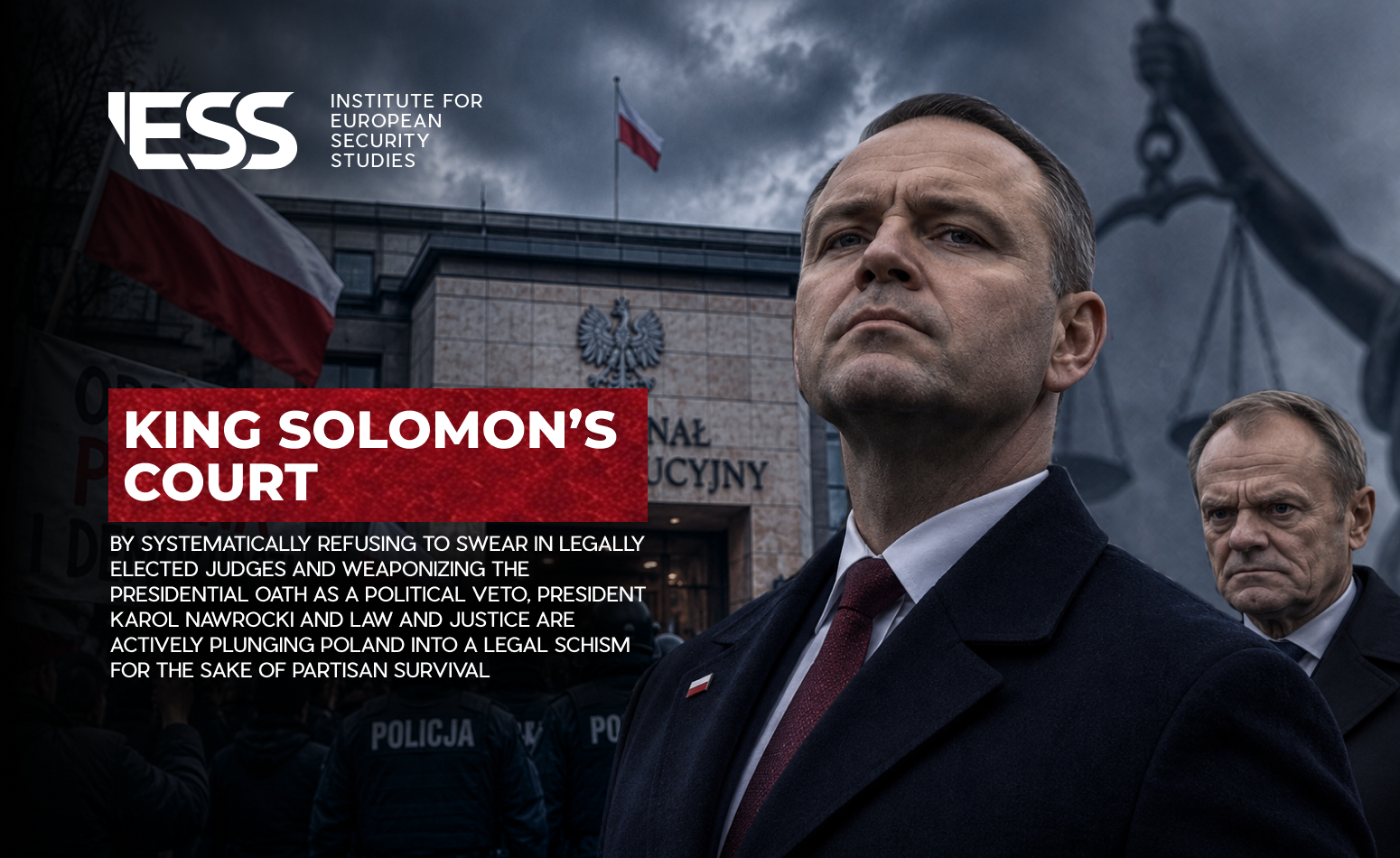
King Solomon’s Court
By systematically refusing to swear in legally elected judges and weaponizing the presidential oath as a political veto, President Karol Nawrocki and Law and Justice are actively plunging Poland into a legal schism for the sake of partisan survival
The constitutional crisis threatening Poland’s statehood does not stem from administrative squabbles within the Constitutional Tribunal, but directly from the presidential palace. At the heart of this institutional breakdown is President Karol Nawrocki’s deliberate refusal to administer the oath of office to a group of judges legally elected by parliament, effectively transforming a ceremonial duty into an illegal veto over democratic appointments.
By treating the presidential oath as a discretionary political tool, Nawrocki has positioned himself as an ideological gatekeeper, blocking the routine and lawful turnover of the court. This obstruction reached a boiling point in Warsaw on October 30, when police were required to secure the court building after Judge Anna Korwin-Piotrowska moved to remove Constitutional Tribunal President Bogdan Święczkowski and his deputy.
Rather than honoring parliament’s constitutional prerogative, the president created the very power vacuum that brought partisans to the streets, leaving Prime Minister Donald Tusk to defend state institutions from coordinated presidential assault.
Rather than working to calm the institutional tremors, the presidency chose to escalate them. Nawrocki abruptly cut short an official visit to Senegal, returning to Warsaw to declare the leadership change at the court a violent takeover and a direct threat to internal security. Almost simultaneously, former Prime Minister Mateusz Morawiecki announced his readiness to table a vote of no confidence against Tusk's cabinet.
The speed of this political choreography suggests that the right-wing opposition views chaos within the judiciary not as a constitutional emergency to be resolved, but as the primary battering ram for its own return to power.
Manufacturing the siege
What unfolded outside the Constitutional Tribunal at the end of October was the predictable culmination of a strategy designed to keep Poland's legal system in a state of permanent contestation. For months, Tusk's governing coalition has sought to restore the court's impartiality following years of partisan capture under previous PiS administrations. Yet every procedural step toward renewing the bench has been met with coordinated resistance from the presidential palace and its parliamentary allies.
By framing the internal removal of Święczkowski as an illegal coup, Nawrocki and Morawiecki have attempted to shift the dispute from the realm of constitutional law into the arena of street politics and national security.
When a sitting president characterizes a dispute over judicial administration as a threat to internal security, he implicitly questions the legitimacy of the state's law enforcement apparatus.
Calling for the fall of the government over a court leadership transition reveals the underlying motive of the conservative camp: preserving a partisan holdout within the Tribunal that can veto or paralyze the legislative agenda of the elected parliamentary majority.
Weaponized oath
Beneath the opposition's rhetoric of building takeovers and no-confidence motions lies this core reality: by refusing to confirm duly elected judges, President Nawrocki has deliberately subverted state continuity and inverted his constitutional role.
In Poland's constitutional framework, the parliamentary election of judges is the decisive act of democratic appointment, while the presidential swearing-in ceremony is intended as a formal confirmation of state continuity. By treating the presidential oath as a discretionary political veto, Nawrocki has inverted his constitutional role.
Instead of acting as an impartial arbiter who ensures the smooth functioning of state organs, the president has positioned himself as an ideological gatekeeper who decides which parliamentary votes count.
This stalling has turned what should have been a routine generational and institutional turnover on the bench into an existential struggle for control over the court.
When the head of state refuses to recognize duly appointed judges, he forces the judiciary into a medieval-style schism – like rival claimants to a papal throne, factions within the same building cease to recognize each other's authority, administrative decisions are treated as hostile acts, and the court loses its capacity to function as a single, coherent institution.
The trap of dual legislation
The broader danger of this confrontation is the normalization of dual legalism in one of Europe's most important frontline states. As the government and the presidency trade accusations of illegal seizures, Poland is sliding toward a system where competing political camps recognize entirely different legal realities.
For ordinary citizens and businesses, the consequences of this artificial deadlock are corrosive: public trust in the justice system cannot survive when the legitimacy of the country's highest constitutional court depends on which political party a citizen happens to support.
Every ruling issued by a contested bench carries an asterisk, creating legal uncertainty that ripples down through the lower courts and weakens the enforceability of state decisions.
Right-wing forces have calculated that by dragging out this conflict, they can exhaust the Tusk administration, forcing the government to spend its political capital on endless procedural trench warfare rather than governance. Yet the price of this partisan attrition is paid by the Polish state itself.
At a moment when Warsaw faces relentless external hybrid pressure and sabotage along its borders, its political leadership is consumed by a self-inflicted crisis of authority.
Restoring the rule of law in Poland requires ending the practice of presidential obstruction and returning to a baseline democratic principle: constitutional procedures are binding rules of statecraft, not optional tools for the opposition.