
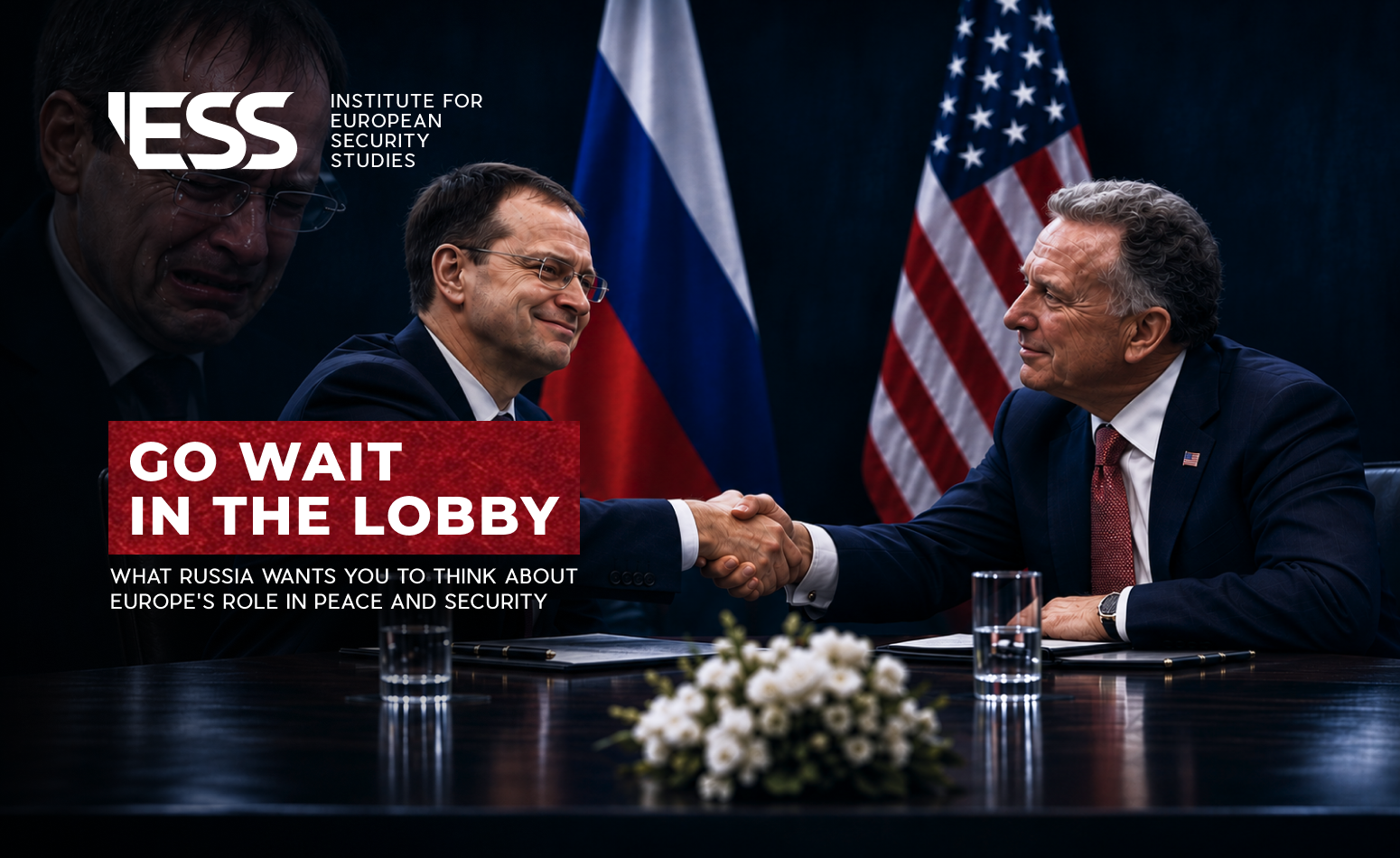
Go Wait in the Lobby
Russia's chief negotiator told European diplomats in Abu Dhabi to go socialize in a hotel bar while Washington and Moscow discussed Europe's own security order without them, and the continent has yet to give Moscow a reason to treat it any other way
Two days of talks in Abu Dhabi between Ukrainian, American, and Russian delegations produced one concrete result, an agreement on a large new prisoner exchange, and one open door: Steve Witkoff and Jared Kushner will travel to Moscow to see Vladimir Putin before meeting Volodymyr Zelenskyy in Dublin, after which a further round of negotiations could be scheduled.
Kushner called territorial questions the hardest part of the process and said the real subject under discussion was nothing less than the postwar security order for Ukraine and Europe as a whole. Russia's chief negotiator, Vladimir Medinsky, agreed with that framing almost word for word, and then made clear exactly whose voice he thinks should be absent while that order gets decided.
What Abu Dhabi actually produced, and why that was the ceiling
Before getting into what Medinsky said to and about Europe, it is worth being clear about what these talks were and were not. The only concrete outcome was an agreement on a large new prisoner exchange, which matters to the families involved and has genuine humanitarian weight. Everything else, the next Moscow visit, the Dublin meeting with Zelensky, the possibility of another round, amounts to a schedule for more talks. That is not a small thing in diplomatic terms, but it is very far from a peace process with momentum behind it.
The reason is structural. Of the three parties at the table, only one is genuinely interested in a ceasefire: Ukraine, which has consistently signaled readiness for a negotiated end to hostilities and uses every available format, including this one, to bring its soldiers home and stop the killing. Russia is participating to look constructive on the outside, particularly to an American administration that wants to announce diplomatic progress, while in substance its delegation arrived with, in Arahamiya's own words, "very strict directives with no room for bargaining." Moscow's goal in these talks is not to reach an agreement; it is to demonstrate enough engagement to keep Washington talking while continuing to press militarily.
And the Trump team is there to serve its own calculation: the political optics of a peace initiative, the economic optics of the diesel deal with Moscow, and the interests of the people around Witkoff and Kushner in whatever commercial arrangements they are pursuing. When only one party at the table actually needs the war to stop, the ceiling on any round of talks is exactly what Abu Dhabi produced: a prisoner swap and a next appointment.
Medinsky confirmed that Russia's delegation did not speak to the European officials present in Abu Dhabi at all, saying Moscow does not understand what status they hold. Asked, in effect, what Europe would need to do to earn a seat, he answered that it would take European leaders developing a conscience. On their actual presence in the city, his advice was blunter still: if the Europeans came as tourists, they could go socialize in the hotel lobby bar, and it might do them good to learn common sense, realism, and a genuine desire for peace from the American envoys instead.
Europe security discussion without Europe: why would it be?
The contempt would be easier to dismiss as a rhetorical flourish if Medinsky weren't simultaneously insisting that European security is the actual point of these talks. He told reporters the central theme of the Abu Dhabi meetings was building a new European security architecture, and repeated Russia's long-standing demand that NATO withdraw to its 1997 borders, the same ultimatum Moscow delivered to Washington in December 2021, two months before the full invasion of Ukraine.
Russia, in other words, is asking to renegotiate the security arrangements of an entire continent, roll back three decades of NATO enlargement, and limit the ability of non-NATO post-Soviet states to cooperate militarily with the alliance, all while declining to exchange a single word with representatives of the states whose security is supposedly under discussion.
A negotiator who wants to redesign a house does not usually start by locking the owners out of the room.
Contempt as a negotiating position
None of Medinsky's language reads like an undiplomatic lapse. He accused European governments of engaging in "collective deception" of the Ukrainian people, argued that states financing and arming Ukraine have no standing to discuss peace since they are, in his framing, complicit in the deaths the war produces, and claimed Russia has not received a single peace proposal from any European capital.
Each claim is calibrated to the same goal: justify treating Europe as a bystander rather than a party, so that whatever Moscow eventually agrees to with Washington can be presented to European governments as a fact to accept rather than a deal to help shape.
A delegation that genuinely wanted no relationship with European counterparts would simply not mention them.
Medinsky mentioned them repeatedly, because insulting a party publicly while excluding it from substance is itself a message, aimed less at the diplomats in that lobby than at the leaders back home watching how little it cost Russia to say it.
Washington wants Europe at the table, however Moscow decides who sits down
Kushner's own language sat only a short distance from Medinsky's, which is the detail worth sitting with. He said plainly that "we must have Europe at the table" and called the EU and NATO presence in Abu Dhabi useful, a genuine difference from Moscow's position. But he also suggested Europe should settle on a single representative to speak for it, since it remains, in his telling, a union of different countries with different interests, a framing that treats Europe's fragmentation as the practical obstacle to its own inclusion rather than something Washington is prepared to work around.
The actual substantive track, the Moscow visit, the Zelenskyy meeting, the next round's scheduling, runs entirely through the US-Ukraine-Russia channel. Europe's seat at the table, even in the version of this process that wants it there, currently amounts to an invitation to first solve its own coordination problem before anyone else will solve it for them.
Why Moscow can afford the insult
This posture only works if it costs Russia nothing, and so far it hasn't. Individual European leaders have spent recent weeks arguing publicly that the war is exhausting the continent and that the EU should simply join whatever negotiation produces a result, a framing IESS has already flagged as indistinguishable from the fatigue narrative Russian state media has run since 2022.
Medinsky's lobby-bar remark was not really a joke about hotel amenities. It was an accurate read of how much weight Europe's collective voice currently carries at a table where the only other two parties, by his own account, are the ones who actually matter.
That reading will keep being accurate until Europe makes it expensive to hold.
The lesson of Abu Dhabi is that disrespecting European diplomacy currently carries no price Moscow needs to budget for. As long as that remains true, the Kremlin will keep using the continent as leverage against a White House that, unlike most of Europe, has not positioned itself unambiguously on Ukraine's side of this war.
And will keep deciding, unilaterally, which chairs at the table actually count.