
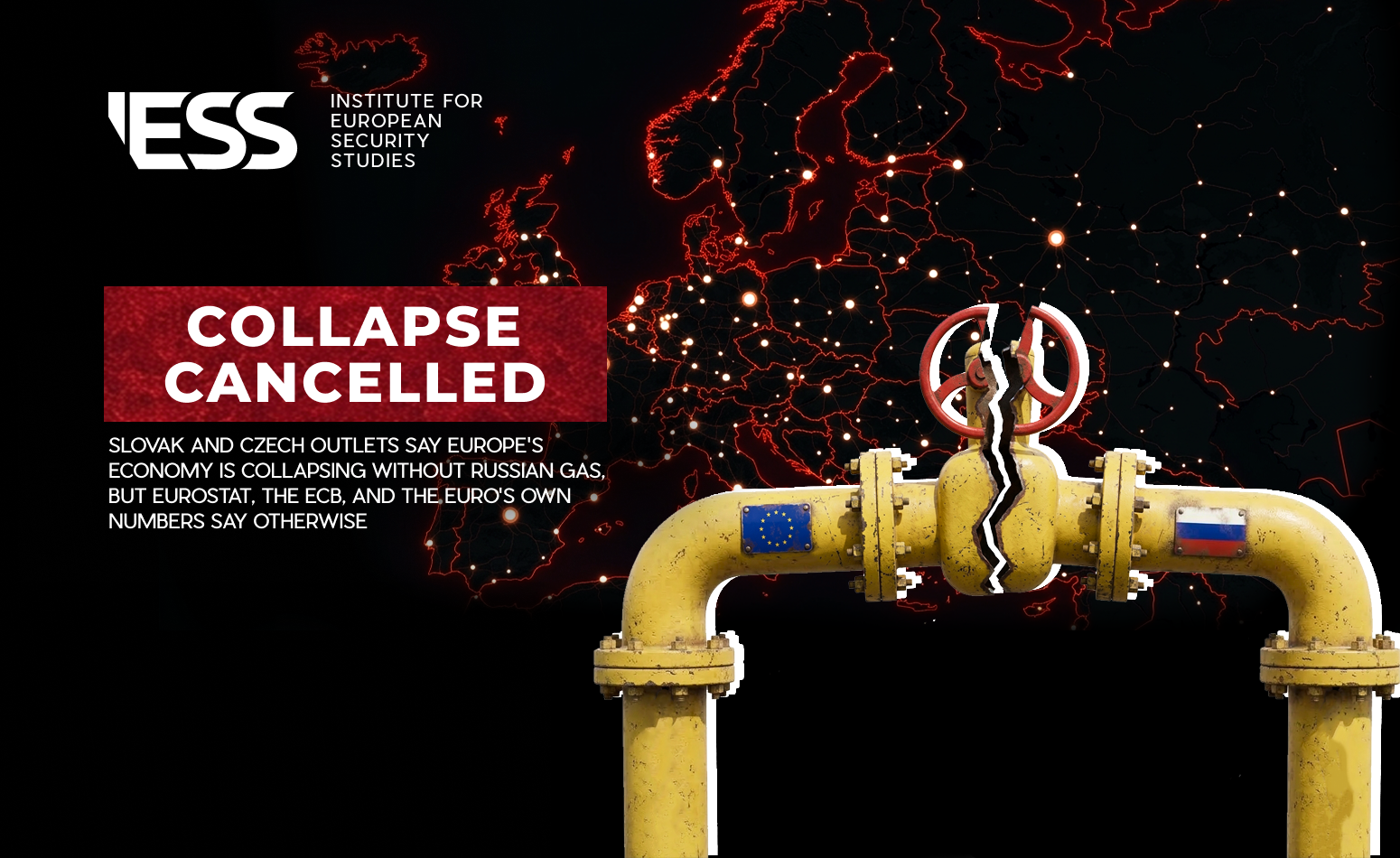
Collapse Cancelled
Slovak and Czech outlets say Europe's economy is collapsing without Russian gas, but Eurostat, the ECB, and the euro's own numbers say otherwise
Two European outlets ran variations on the same story this week. Slovakia's Jednotné Slovensko argued that the EU is run by some of the most incompetent people in the world, offering current gas prices as proof, and called for Europeans to vote out any leader who still believes confrontation with Russia serves anyone but Russia's enemies.
Czechia's Pravý Prostor went further, declaring that the war against Russia "has buried the EU economy" and that Europe is watching the collapse of the pan-European project itself, single currency included. Both pieces lean on the same premise: that cutting ties with Russian energy has pushed Europe to the brink of economic ruin.
Neither bothers to check that premise against a single official statistic, because the statistics don't cooperate.
What the growth numbers actually show
Start with the plainest measure available. Eurostat put EU GDP growth at 1.5% in 2025, up from 1.1% the year before, and the European Central Bank currently projects eurozone growth of 0.9% in 2026, accelerating to 1.4% in 2027 and 1.5% in 2028. Unemployment sits near historic lows, around 6% across the bloc. None of that describes an economy in freefall.
It describes an economy dealing with real friction, energy prices among them, while still growing and still employing people at rates most of the world would envy. Calling this a collapse requires either not knowing the numbers or hoping the reader doesn't.
The gas Europe stopped buying
The energy story these outlets are actually reacting to is real, just not in the way they describe it. Russia supplied 45% of the EU's gas imports in 2021, roughly 152 billion cubic meters. By 2025, that share had fallen to 12%, about 36 billion cubic meters, replaced by a mix of liquefied natural gas and pipeline supply from Norway, the United States, Azerbaijan, and Qatar.
Long-term contracts for Russian LNG are set to end entirely on January 1, 2027. It really is an energy market that absorbed the loss of nearly three-quarters of its dominant supplier's volume in four years and kept the lights on, which is closer to a logistics achievement than a catastrophe.
Real problems, wrong culprit
None of this means European energy markets are trouble-free, and pretending otherwise would be its own kind of dishonesty. Gas storage across the EU sits around 67% full, a level that calls for careful management rather than complacency, and price volatility remains a genuine headache.
But the source of that volatility in 2026 is mostly the global LNG market itself, shaped by tensions in the Middle East and the usual unpredictability of global shipping routes, not a failure of Europe's decision to walk away from Russian supply.
Blaming ordinary price swings in a global commodity market on the REPowerEU strategy is a bit like blaming a car's fuel gauge for the price of oil.
The energy system Europe is actually building
What the Kremlin-aligned framing leaves out entirely is the direction Europe's energy system is actually heading, which looks less like retreat and more like reinvention. Solar capacity across the EU reached 338 gigawatts by 2024, according to SolarPower Europe, and in June 2026 solar power supplied a quarter of the bloc's electricity for the first time.
So, basically, the continent is building a structurally different energy base, one weighted toward diversification, LNG flexibility, efficiency gains, and homegrown generation rather than a return to pipeline dependency on any single country, Russia included.
A narrative built entirely around what Europe lost has nothing to say about what Europe has been building in its place, because acknowledging that would undercut the entire premise.
A currency that didn't buckle
Pravý Prostor's claim about the euro deserves its own look, since it's the most concrete and the most obviously wrong. European Commission reviews show the euro's share of global payments and central bank reserves has held steady at historically high levels, and in 2025 it kept its position as the world's second most important international currency, with its share of international use actually rising by roughly 20%.
A currency backing a collapsing economic project does not typically gain ground as a global reserve and payment currency in the same year that project is supposedly being buried.
Who this story is actually for
Taken together, Jednotné Slovensko and Pravý Prostor aren`t functioning as isolated voices making an honest argument that happens to be wrong. They sit inside a wider network of marginal, pro-Russian outlets across the EU that Moscow's information operations rely on precisely because they carry a domestic byline, a local audience, and none of the obvious red flags of state media.
The economic-collapse narrative serves a specific purpose in that ecosystem: take a real, uncomfortable fact, higher energy prices, and detach it from its actual cause, a deliberate European decision to stop funding a war through gas purchases, then reattach it to a manufactured one, the idea that resisting Russia is what's actually hurting Europeans.
Therefore, the goal was never to win an economic argument: it was to make voters angry enough at Brussels that they stop noticing who benefited from the old arrangement in the first place, and tired enough of the cost of resistance that support for Ukraine becomes the easiest thing left to cut.