
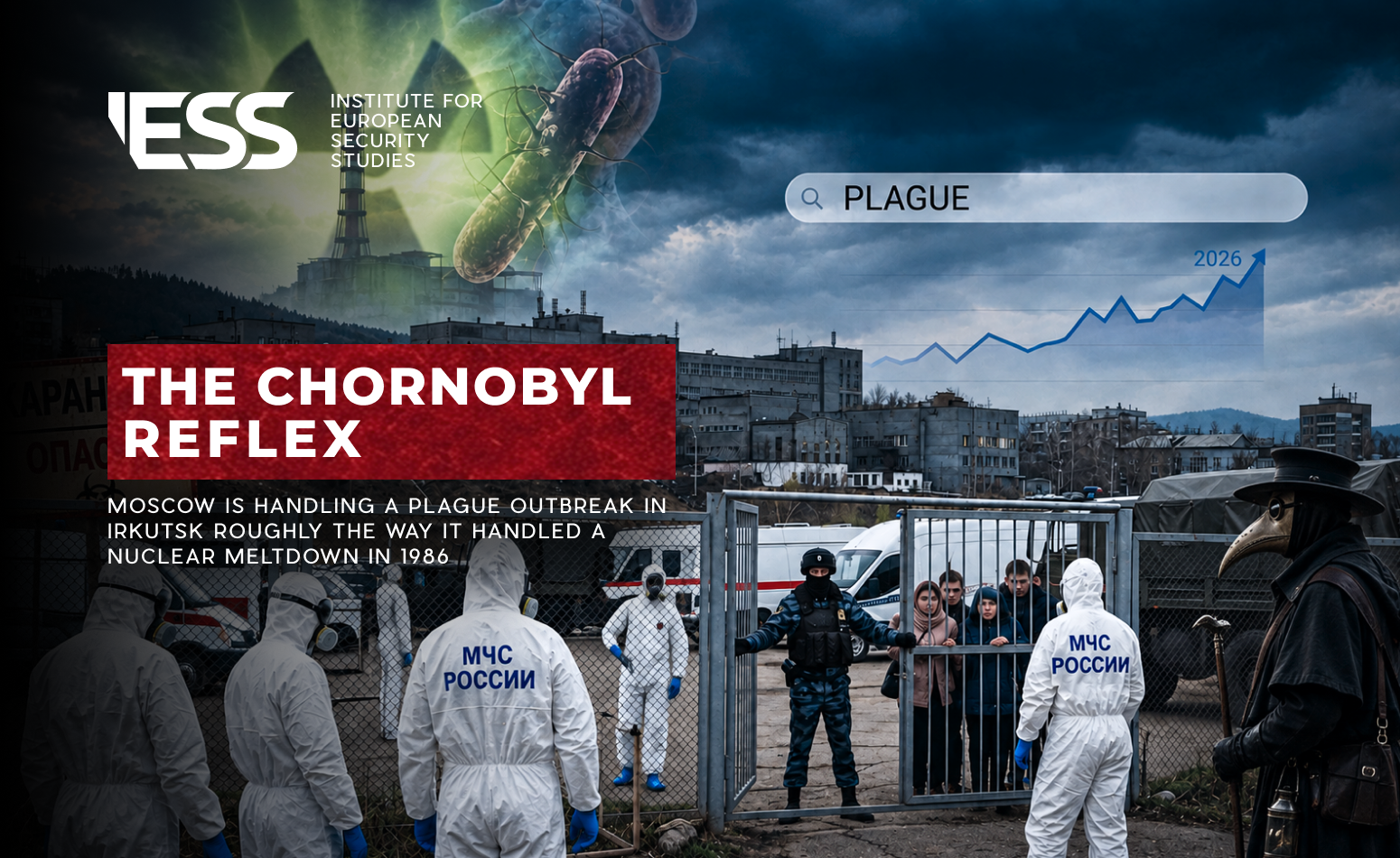
The Chornobyl Reflex
Moscow is handling a plague outbreak in Irkutsk roughly the way it handled a nuclear meltdown in 1986
On October 2, Russian authorities confirmed that a 27-year-old lab technician at the Irkutsk Anti-Plague Institute, Daria Shipilova, had died. What they did not confirm is what killed her. Rospotrebnadzor, the health regulator, attributed her death to "pneumonia of unestablished etiology," a phrase doing a great deal of work for an employee of an institute whose entire purpose is studying plague. One account circulating holds that she broke a test tube containing the pathogen in her own laboratory on September 25.
Another holds that she had just returned from fieldwork in Buryatia, near a known plague focus on the Mongolian border. Both explanations point to the same conclusion the official one carefully avoids stating outright.
Within days, three of Irkutsk's city clinical hospitals, a children's hospital, and a maternity ward were placed under a three-week quarantine. More than 200 people who had contact with Shipilova were isolated, several of them, by multiple accounts, under armed escort from Russia's security services rather than by ordinary medical transport. An aluminum plant in nearby Shelekhov introduced what it called a "mask regime."
None of this is how a government responds to pneumonia of unknown origin – it is how a government responds to plague while declining to use the word.
A playbook forty years old
Millions of Soviet-born people of a certain age have seen this sequence before, and so has the rest of the world, under a different name and a different hazard. Moreover, roughly half a year ago IESS analyzed how Moscow deals with emergencies of this kind.
So, in April 1986, Soviet authorities said nothing publicly for two days after the 4th Chornobyl NPP reactor exploded, let Kyiv's May Day parade proceed as scheduled while radioactive fallout drifted overhead, and only acknowledged the disaster once Swedish monitoring stations detected elevated radiation and demanded an explanation Moscow could no longer withhold. The pattern wasn't secrecy for its own sake.
It was a specific sequence: deny first, manage the optics second, and treat public panic as a bigger administrative problem than the hazard itself.
That sequence is visible almost beat for beat in Irkutsk. Governor Igor Kobzev's public comment amounted to acknowledging an unnamed "especially dangerous infection" under strict control, before his office's communications pivoted back to routine coverage of regional youth forums, as though the quarantine of five medical facilities were a footnote rather than the story. Regional officials and outlets that had posted early warnings about the outbreak quietly deleted them.
The Kremlin's broader reflex wasn't to contain a bacterium, but to contain the sentence describing one, and that reflex is the same one Moscow's predecessor state ran in 1986, only compressed from weeks into days because information now travels faster than Soviet bureaucracy ever had to account for.
What "mask regime" and armed convoy have in common
The contrast between Shelekhov's masks and the armed isolation of Shipilova's contacts is itself revealing. A functioning public health response to a pneumonic plague exposure looks like contact tracing, antibiotic prophylaxis, and transparent risk communication, because the disease is treatable if caught early and devastating if it isn't.
What Irkutsk got instead was theater at the industrial end, a mask requirement framed as routine prevention, and coercion at the clinical end, more than 200 people held under guard with essentially no public accounting of their condition or release timeline.
Those are not two different tools serving one coherent public health strategy, because they are standing for two different performances for two different audiences: reassurance for workers who need to show up to the plant, and control for anyone who might otherwise talk.
The search bar says what officials won't
Russians did not need state media to tell them something was wrong, and the clearest evidence of that is also the hardest for the Kremlin to delete. Between September 29 and October 5, searches for the word "plague" inside Russia's Google traffic rose roughly 2,800%, a spike no amount of reassurance from presidential spokesman Dmitry Peskov, who publicly urged people not to spread "speculation," managed to flatten.
Therefore, people do not search a word that aggressively because they trust the official explanation, but because the official explanation doesn't match what they're watching happen to their own hospitals, and in the absence of real information, millions of individual search queries become the only honest survey of public alarm the Kremlin can't quietly erase the way it erased the warnings themselves.
A health system with no slack left
None of this is unfolding inside a healthcare system with spare capacity to absorb a crisis gracefully.
Russia's medical workforce has been thinned by years of wartime budget pressure, a strain IESS has already traced through the broader fiscal picture: a government now financing roughly 43.8% of federal spending through defense and security, with little left over for the civilian institutions, hospitals included, that would normally handle exactly this kind of emergency.
A country with enough trained epidemiologists, isolation capacity, and antibiotic stockpiles doesn't need to shut down five medical facilities and detain contacts under armed guard to manage a few hundred exposures. It needs to do that specifically when the system lacks the staff, supplies, and protocols to respond any other way, and coercion becomes the substitute for competence.
Why Washington and Brussels are watching a Siberian institute
The US government and the European Commission have both said they are monitoring the Irkutsk situation and pressing Moscow for prompt, transparent information, an unusual level of attention for what Russian officials insist is a contained regional matter.
That attention isn't really a judgment about how large the outbreak actually is; nobody outside Russia's own security services currently has reliable data to make that call.
It's a judgment about what Moscow's behavior so far reveals about how it would handle a genuinely large outbreak if one occurred, and the answer, based on the deleted warnings and the unexplained death certificate, is not reassuring.
A government willing to detain 200 people under guard rather than explain plainly what they were exposed to, and willing to delete its own regional officials' warnings rather than let residents judge the risk for themselves, is not a government anyone should expect to manage a larger epidemic more openly.
The lesson of Chornobyl was never that the Soviet state lacked the scientific capacity to detect a disaster, however, it was about Moscow`s reflex to control the story outpaced its abilities to control the hazard, and by the time the world found out the truth from someone else's radiation detectors, the decisions that mattered most had already been made in silence.
Nearly forty years later, the reflex hasn't changed. Only the pathogen has.