
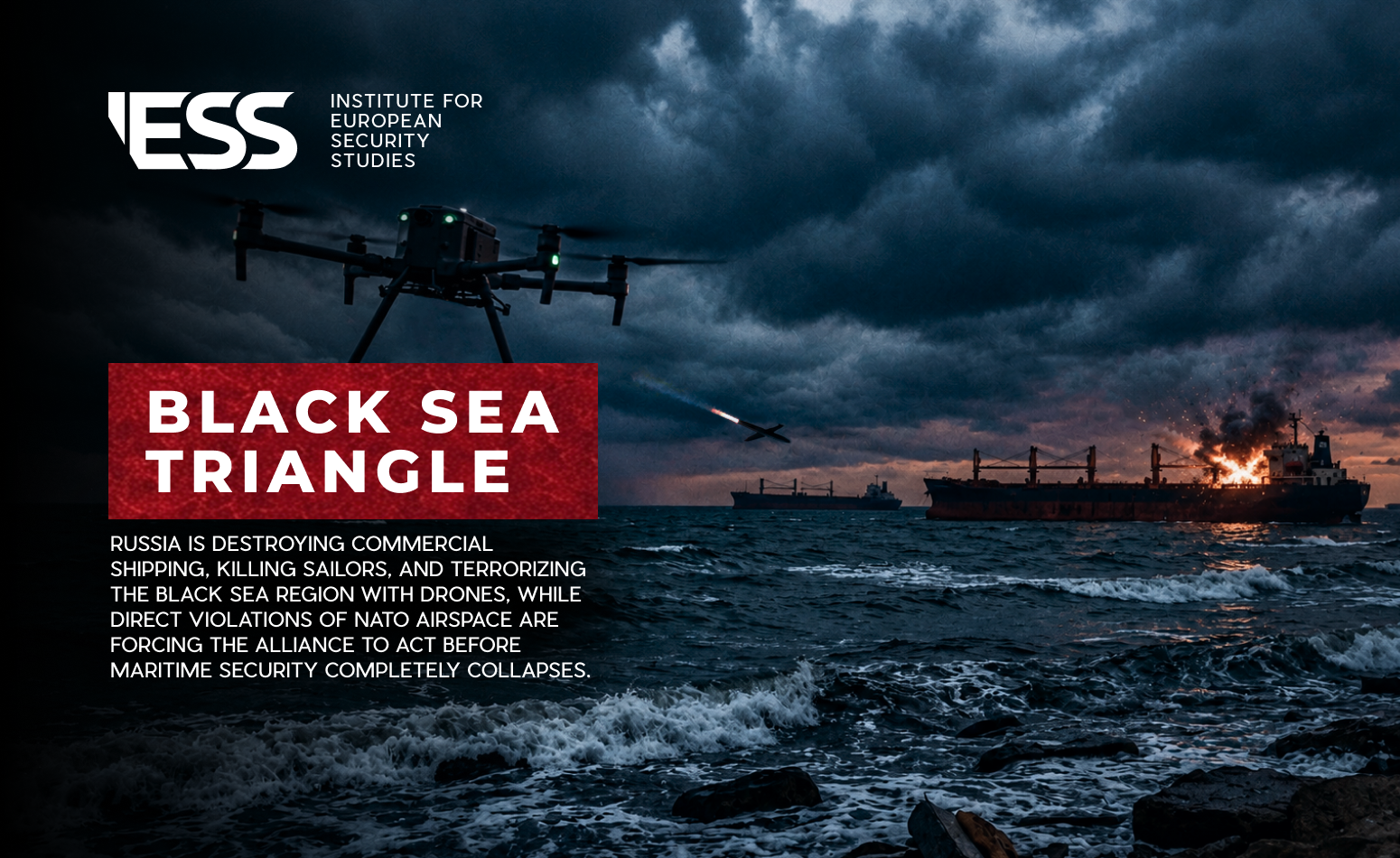
Black Sea Triangle
Russia is destroying commercial shipping, killing sailors, and terrorizing the Black Sea region with drones, while direct violations of NATO airspace are forcing the Alliance to act before maritime security completely collapses.
The Black Sea is rapidly emptying of civilian traffic, not through a formal naval blockade, but through a fleet of nameless drones.
By mid-October, what began as a series of alarming incidents off the coasts of Romania and Bulgaria has metastasized into a sustained, lethal campaign against commercial shipping.
The mathematics of this escalation are grim: seven merchant vessels struck, two sailors confirmed dead, and at least twenty-five crew members missing at sea.
Crucially, the geography of this violence is shifting. The wave of strikes on October 14 and 15 did not just harass vessels in exclusive economic zones (EEZ), as one of the drones hunted its target straight into Romanian sovereign territorial waters.
The escalation culminated on October 17, when Romanian F-16 fighter jets from the 86th Borcea Air Base intercepted and destroyed two jet-powered "Geran" strike drones violating Romanian airspace over the Black Sea. Detected approximately 120 km east of Zmiinyi Island, the first drone was shot down at 18:01 southeast of Sulina after spending two minutes in Romanian airspace, followed by the second at 18:05 east of Sulina after five minutes.
The gray zone is shrinking, and the war has physically spilled over the boundaries of the North Atlantic Alliance.
Yet, officially, the perpetrators remain ghosts. Authorities in Bucharest and Sofia have confirmed the strikes, but the technical origin of the drones remains unverified. The Bulgarian government has been particularly explicit, stating that it is currently “impossible to prove Russian responsibility legally”.
From a strict forensic standpoint, Sofia is correct: plausible deniability is the foundational principle of hybrid warfare
But from a geopolitical perspective, waiting for a smoking gun while civilian sailors are being slaughtered in NATO waters is an exercise in strategic self-delusion. In international security, when technical attribution fails, analysts must rely on a much older and more reliable metric: cui bono? Who benefits?
The motives behind this escalation are obvious. There are no nameless terrorists in the Black Sea with the resources for large-scale attacks on ships. There is only one state that benefits from making this region either entirely Russian or completely dead to shipping.
The Kremlin seeks to block Ukraine's economy without formally involving its navy. By launching unmarked drones, Moscow forces insurance companies to raise rates to unaffordable levels and crews to refuse voyages, creating a de facto naval blockade.
Moreover, by launching unattributed drones into international and NATO-adjacent waters, Moscow achieves a de facto naval blockade without ever issuing a formal declaration of one.
This phantom campaign serves a dual purpose.
First, it terrorizes the commercial shipping sector, violently disrupting the grain routes that are vital to both the Ukrainian economy and global food security.
Second, it probes the psychological resilience of NATO at a moment when the United States is effectively abandoning its commitments to Ukraine and the Alliance's eastern flank. The hesitation from Brussels stems from a deeper dread: reacting too forcefully might expose the reality that Washington will not provide military backing, triggering an unmistakable collapse of NATO's collective security guarantee.
Exploiting this geopolitical vacuum, Moscow has pushed its aggression well beyond its previous limits, sinking commercial ships in exclusive economic zones in what amounts to an unambiguous act of war.
Not hybrid war. Very real, conventional war.
These targeted strikes violate foundational principles of international maritime law and directly undermine freedom of navigation – a vital interest that the United States historically swore to defend, but is now actively betraying in the Black Sea theater.
NATO has announced that it will review its defensive posture in the Black Sea in light of the escalating threat, yet a bureaucratic review is precisely the kind of sluggish, non-kinetic response that emboldens hybrid actors.
If a hostile power can sink civilian ships and kill foreign nationals inside NATO waters, while escaping consequences simply by omitting a national flag from the fuselage of its drones – then international maritime security has effectively collapsed.
The international community can continue to search for technical attribution, or it can acknowledge the obvious: only one state benefits from an empty, terrified Black Sea, and Russia is actively enforcing that reality right now.